
Perseverance Robot Launches to Detect Life on Red Planet

The
one-tonne, six-wheeled rover was launched out of Florida by an Atlas rocket on
a path to intercept the Red Planet in February next year.
When
it lands, the Nasa robot will also gather rock and soil samples to be sent home
later this decade.
Perseverance
is the third mission despatched to Mars inside 11 days, after launches by the
UAE and China.
Lift-off
from Cape Canaveral Air Force Station occurred at 07:50 local time (12:50 BST;
11:50 GMT).
Nasa made this
mission one of its absolute priorities when the coronavirus crisis struck,
establishing special work practices to ensure Perseverance met its launch
deadline.
"I'm
not going to lie, it's a challenge, it's very stressful, but look - the teams
made it happen and I'll tell you, we could not be more proud of what this
integrated team was able to pull off here, so it's very, very exciting,"
Administrator Jim Bridenstine told reporters.
Satellite
images suggest this held a lake billions of years ago.
Scientists
say the rocks that formed in this environment stand a good chance of retaining
evidence of past microbial activity - if ever that existed on the planet.
Perseverance
will spend at least one Martian year (equivalent to roughly two Earth years)
investigating the possibility.
Unlike
the previous four rovers Nasa has sent to Mars, its new machine is equipped to
directly detect life - either current or in fossilised form.
But
any evidence it uncovers will almost certainly have its sceptics, which is why
researchers want to bring whatever Perseverance finds back home for the deeper
analysis only sophisticated laboratories on Earth can perform.
The
rover will therefore package its most interesting rock discoveries in small
tubes. An elaborate mix of future missions will then launch later this decade
to try to retrieve these samples.
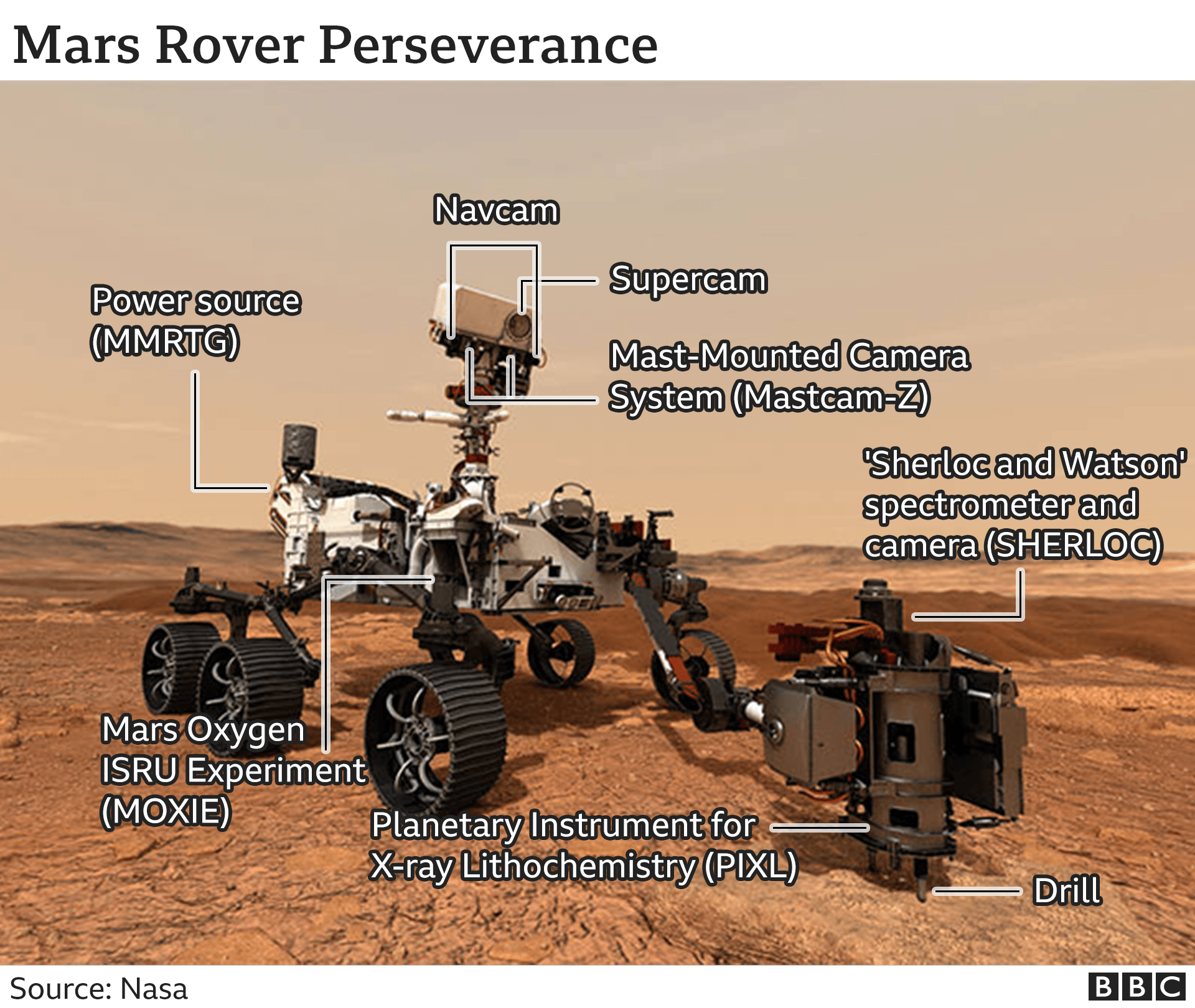
At first glance,
Perseverance looks to be a copy of the Curiosity robot Nasa sent to Mars' Gale
Crater in 2012. Indeed, the new robot even incorporates some leftover parts
from the earlier mission.
But
the seven instruments on Perseverance are either major upgrades or totally new.
Expect
some remarkable new imagery from the 23 cameras on the vehicle - and sound,
because the Perseverance mission carries microphones as well.
"We
hope to capture some of the sounds of entry, descent and landing; and some of
the sounds of driving around, merging that with the video we can take,"
explained Jim Bell, the principal investigator on the rover's mast-mounted
camera system, MastcamZ.
In
addition to geological investigations and the search for life, there's an
emphasis on future human exploration.
The
Moxie instrument will practise making oxygen from Mars' carbon
dioxide-dominated atmosphere; and there are even samples of spacesuit material
aboard to see how they cope in the planet's harsh environment.
This is purely a
technology demonstration. Ingenuity aims to prove that aero vehicles can
operate in Mars's rarefied air.
The
1.8kg machine will be deployed from Perseverance's belly once a suitable
location for its flight experiments has been identified.
Ingenuity's
twin, counter-rotating blades will have to spin extremely fast to get off the
ground.
Engineers
have five sorties planned over a 30-day period, with the ambition on each
excursion of climbing ever higher into the sky and getting further away from
Perseverance.
"Today,
we simply don't use the aerial dimension in space exploration, but in future we
will," said Nasa's Ingenuity project leader, MiMi Aung. "They will be
used, for example, in a scouting function. When humans arrive, or indeed future
rovers, the rotorcraft will go in front and gather high-definition images of
the way ahead," she told BBC News.
Jezero is named
after a town in Bosnia-Herzegovina. In some Slavic languages the word
"jezero" also means "lake" - which should explain the
fascination.
This
500m-deep bowl once saw huge volumes of water flow in through the western wall
to pool on the crater floor.
Where
the water entered, it even deposited sediments to form a delta. Perseverance
will try to land next to this feature.
Jezero
displays multiple rock types, including clays and carbonates, that have the
potential to preserve the type of organic molecules that would hint at life's
bygone existence.
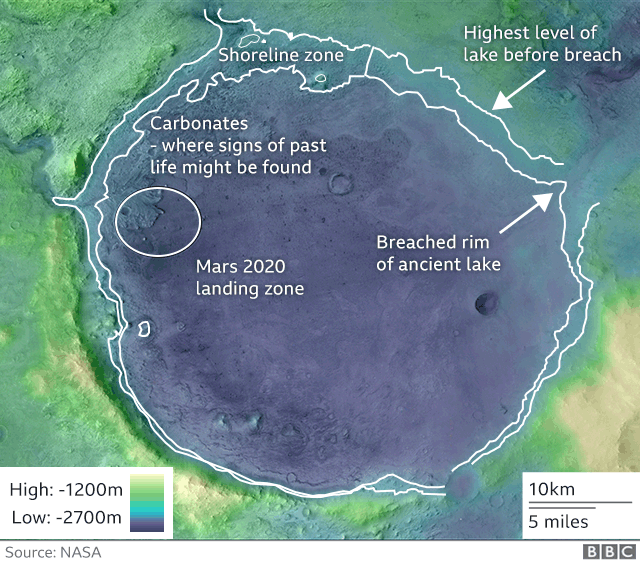
Particularly
enticing is the "bathtub ring" of sediments laid down at the ancient
lake's shoreline. It's here that Perseverance could find what on Earth are
called stromatolites.
"These
are ancient fossilised microbial mats," explained rover deputy project
scientist Katie Stack Morgan.
"They
leave behind very thin layers, with concentrations of particular elements and
organics at repeated intervals. We'll be looking for those fine laminations,
looking for chemistry and textures you wouldn't expect if these things were
just abiotic, or didn't involve life."
We know from the
search for the earliest life on Earth that the evidence can sometimes be
controversial.
So,
even if Perseverance stumbles across rocks that appear to have been fashioned
by some ancient Martian biology, it will almost certainly require confirmation
by analytical instruments on Earth that are far superior to the miniaturised
versions carried on the rover.
That's
why a key task for Perseverance will be to package its most interesting rocks
in small metal canisters and leave them on the Jezero Crater floor.
Nasa
and the European Space Agency (Esa) intend to go fetch these tubes with two
more missions that are scheduled to leave Earth in 2026.
It's a remarkable
endeavour involving a second rover, a Mars rocket and a huge satellite to ship
the sample tubes home, getting them here in 2031. "You can argue that what
we'll be trying to do is as complicated as the Apollo Moon landings - when you
think of the complexity of the robotics involved," David Parker, director
of human and robotic exploration at Esa, told BBC News.
"And
it will also be a step on the way to sending humans to Mars because the
architecture of this Mars Sample Return project is really a scale model of a
human mission with its multiple vehicles that have to launch, land, launch
again, rendezvous in orbit and return to Earth."
Nasa
and Esa estimate the total cost of getting samples back to Earth, including the
$2.7bn (€2.3bn; £2bn) cost of Perseverance, will come to at least $7bn (€6bn;
£5.4bn).
FROM .bbc.com/news/science-environment
No comments