
Arrested Hong Kong Tycoon Tells Protesters to be 'Careful'
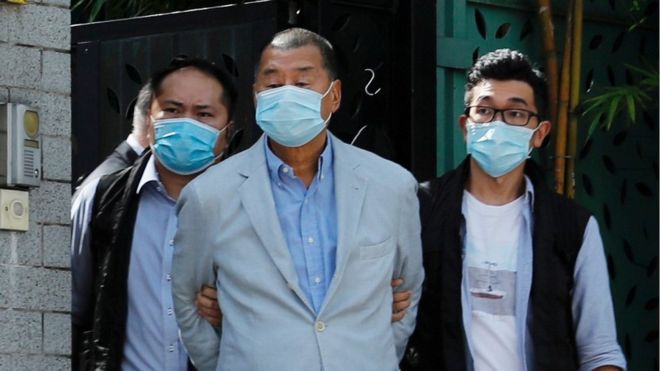
Hong Kong business
tycoon Jimmy Lai - the most high-profile person to be detained under a controversial
new security law has warned young protesters they need to be "more
cautious" now.
Mr Lai was
arrested on Monday, and his newspaper offices raided by hundreds of police, in
scenes that shocked many.
Speaking
after his release on bail, Mr Lai told the BBC he believed his arrest was
"just the beginning".
There will
be "a long fight" ahead for Hong Kong's freedoms, he added.
Mr Lai, who
has been a prominent pro-democracy voice and a supporter of protests that
erupted last year, owns Apple Daily, one of Hong Kong's most-read newspapers.
He and nine
other activists were detained on Monday over allegations including collusion
with foreign forces, under a national security law imposed by China in June.
The sweep of
arrests has raised fears that China will use the new law to undertake a broad
crackdown on Hong Kong's pro-democracy activists and media figures.
Speaking to
Newshour on the BBC World Service, Mr Lai said he was surprised when he
saw police arrive at his home on Monday morning.
While he had
been arrested before, this was "more scary" because it came under the
national security law imposed by China, he said.
Both his
sons were also arrested on "bogus charges", he said, although he
added that he had no regrets about his pro-democracy activism.
"When I
was in custody I could not sleep I was thinking, if I knew that was going to
happen to me now, [with] even more hardship [on the way], would I have done the
same thing?
"I
would not have [done things] another way this is my character," he added.
However, he
warned protesters that they would now have to be "more cautious in our
resistance to preserve our rule of law and freedom", as the sweeping new
security law made the environment more dangerous for activists.
"We
have to be more careful and creative in [our] resistance, we can't be as
radical as before especially young people because the more radical [we are] the
shorter lifespan we have in our fighting.
"We
have to really use our brain and patience, because this is a long fight."
Mr Lai's
arrest has been welcomed by Chinese state media, who have described him as a
"riot supporter" and his publications as having been
"instigating hatred, spreading rumours and smearing Hong Kong authorities
and the mainland for years".
The
businessman is estimated to be worth more than $1bn (£766m).
Having made
his initial fortune in the clothing industry, he later ventured into media and
founded Apple Daily, which is frequently critical of Hong Kong and mainland
Chinese leadership.
In 2019 the
daily was the most-read paid newspaper in the territory, both in print and
online, according to the Chinese University of Hong Kong.
Mr Lai has
also been an activist against Beijing's increasingly tight grip on Hong Kong.
In 2019 he supported and participated in pro-democracy protests that lasted for
months in the territory.
On Tuesday,
the holding company of Apple Daily newspaper saw its stock rise fourfold, as
Hong Kongers rallied behind the newspaper and bought stocks in the company
following Mr Lai's arrest.
Mr Lai's
colleagues and two of his sons were among those arrested on Monday.
Separately,
prominent youth activist Agnes Chow was arrested, as were Wilson Li, who works
as a freelance journalist with UK-based ITV News, and activist Andy Li.
Ms Chow was
released on bail late on Tuesday, and told reporters: "It's very obvious
that the regime is using the national security law to suppress political
dissidents."
Hong Kong
has had a high degree of autonomy since it was returned from British to Chinese
rule in 1997, and its residents have had a far higher level of freedom of
speech and media than people on the mainland.
But the new
law's key provisions include that crimes of secession, subversion, terrorism
and collusion with foreign forces are punishable by a maximum sentence of life
in prison.
It makes it
easier to punish protesters, and reduces Hong Kong's autonomy.
The law also
gives Beijing powers to shape life in the former British colony in a way it
never has before.
Critics say
it effectively curtails protest and freedom of speech. China has said the new
law will return stability to the territory after a year of unrest.
FROM .bbc.com/news/world-asia-china
No comments