
Beirut Explosion: Angry Protesters Enter Foreign Ministry
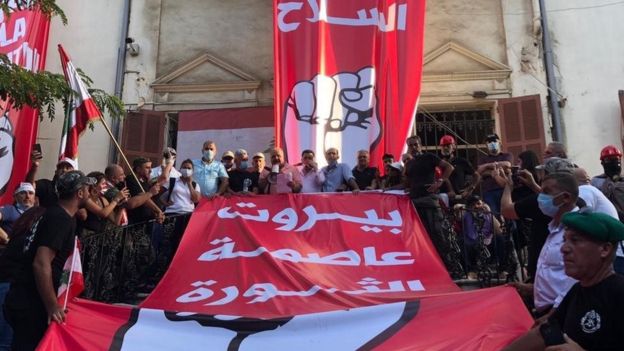
Dozens of
protesters in Beirut have entered the foreign ministry during a wider
demonstration over Tuesday's huge explosion that left at least 158 dead.
Several
thousand people are on the streets in a planned protest, but there has been
violence. Police fired tear gas at stone-throwing demonstrators.
Sounds of
gunfire have also been heard from central Martyrs' Square.
In a speech,
Prime Minister Hassan Diab said he would ask for early elections as a way out
of the crisis.
Many
Lebanese are furious at the failure to prevent the explosion of over 2,000
tonnes of ammonium nitrate.
The
material, which was being stored in a warehouse, had been seized from a ship
six years ago but never moved. The government has promised to find those
responsible.
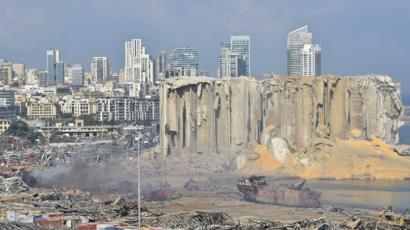
The blast at
the port devastated parts of the city and has deepened distrust of what many
had already seen as an inept and corrupt political class. An anti-government
protest movement erupted last October, fuelled by an economic crisis and a
collapsing currency.
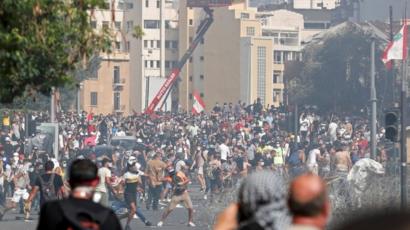
Crowds
estimated at between 5,000 and 7,000 took to the streets in another day of
protest, including a march from one of the most devastated areas near the port
to Martyrs' Square.
Skirmishes
with the police began early on. Some protesters hurled rocks and sticks, and
the police replied with tear gas and rubber bullets. There were flashpoints at
barricades designed to prevent demonstrators reaching parliament.
But a group
of several dozen chanting anti-government slogans and burning a portrait of
President Michel Aoun entered the foreign ministry and called for all
ministries to be occupied.
"We have it. It's all ours. The police is outside the gate. They could not stop us," one of the protesters, who identified herself as Rebecca, told the BBC World Service's Newshour programme.
She said
there were around 100 demonstrators inside the building, who had gained entry
as it was already damaged by Tuesday's blast. She said the protesters intended
to stay as long as possible and occupy other ministries.
Police also
confirmed to Reuters news agency that live ammunition had been fired in central
Beirut, though it is not clear who fired.
Lebanese
media quote the local Red Cross as saying that 110 people have been injured
during the demonstrations - a third have been taken to hospital.
As the
protests got under way, mock gallows were erected in Martyrs' Square to hammer
home the demonstrators' view of the country's political leaders
Apart from
showing the city's anger, the march was also meant to remember victims of the
explosion, which injured 6,000, according to the latest update. Around 300,000
people are homeless.
Global
leaders are scheduled to take part in a virtual donor conference on Sunday
organised by French President Emmanuel Macron.
Mr Macron
was mobbed in the streets by welcoming crowds calling for outside intervention
as he visited Beirut earlier this week in the aftermath of the explosion.
France, the
former colonial power, has close economic ties with Lebanon, which defaulted on
its sovereign debt in March but has been unable to agree a reform programme
with international lenders to obtain a bailout.
Global
leaders are scheduled to take part in a virtual donor conference on Sunday
organised by French President Emmanuel Macron.
Mr Macron
was mobbed in the streets by welcoming crowds calling for outside intervention
as he visited Beirut earlier this week in the aftermath of the explosion.
France, the
former colonial power, has close economic ties with Lebanon, which defaulted on
its sovereign debt in March but has been unable to agree a reform programme
with international lenders to obtain a bailout. US President Donald Trump is
among world leaders set to attend the virtual donor summit.
On Friday,
UN agencies warned of a humanitarian crisis in Lebanon, including possible food
shortages and an inability to continue to fight the Covid-19 pandemic.
Many
countries have already offered aid, with the US announcing on Friday that it
planned to immediately send $15m (£11.5m) worth of food and medicine.
The UK has
released £5m of emergency aid and deployed a Royal Navy ship to Lebanon.
Prime
Minister Boris Johnson spoke to President Aoun on Saturday and conveyed the
UK's "deepest sympathies to the Lebanese people", Downing Street
said.
The Syrian
embassy says 43 Syrians were among those killed as a result of the blast.
Reports suggest some were port workers.
Lebanon hosts
more than a million Syrians following an influx of migrants sparked by the long
conflict in Syria.

Another
casualty was the wife of the Netherlands ambassador. Hedwig Waltmans-Molier
died from injuries sustained in the blast, the Netherlands foreign ministry
said.
A
two-year-old Australian boy, Isaac Oehlers, was also killed, Australian media
say.
The Lebanese
authorities now say 21 people are still missing.
Lebanon's
president and prime minister have said 2,750 tonnes of ammonium nitrate - which
is commonly employed as a fertiliser but can also be used to create an
explosive - had been stored in a warehouse at the port without any safety
precautions since 2014, when it was unloaded from an impounded cargo ship, the
MV Rhosus.
The decision
to keep so much explosive material in a warehouse near the city centre has been
met with disbelief by many Lebanese.
On
Wednesday, Mr Aoun promised a transparent investigation by Lebanese authorities
and to "hold those responsible and those who were negligent accountable,
and serve them the most severe punishment".
However,
calls for an international investigation have grown since then.
The
president ruled out such a move on Friday, saying: "The goal behind calls
for an international investigation into the port issue is to dilute the
truth."
President
Aoun also said the government-backed inquiry was looking into three
possibilities: negligence, accident or what he called "external
interference through a rocket or bomb or other act".
Officials
have said the explosion appears to have been triggered by a fire and there has
been no evidence so far of the third possibility mentioned by Mr Aoun.
Twenty-one
people have been arrested - among them Badri Daher, the director-general of
Lebanon's Customs Authority.
The
Iran-backed Hezbollah movement, which supports the power-sharing government,
meanwhile denied any involvement in the blast, insisting that his group did not
control the port and that it had stored no weapons or ammunition there.
Hezbollah
leader Hassan Nasrallah declared in a speech: "Not a weapons cache, not a
missile factory, not a single missile, not a single rifle, not a single bomb, not
a bullet, not nitrates. Nothing at all. Not now, not in the past."
No comments