
Belarus Opposition Disputes Lukashenko Landslide Win
Svetlana
Tikhanovskaya, the main challenger to Belarus President Alexander Lukashenko
has refused to accept the result of Sunday’s election which the autocratic
president won 80% of the vote.
"I
consider myself the winner of this election," Svetlana Tikhanovskaya said
on Monday.
This follows
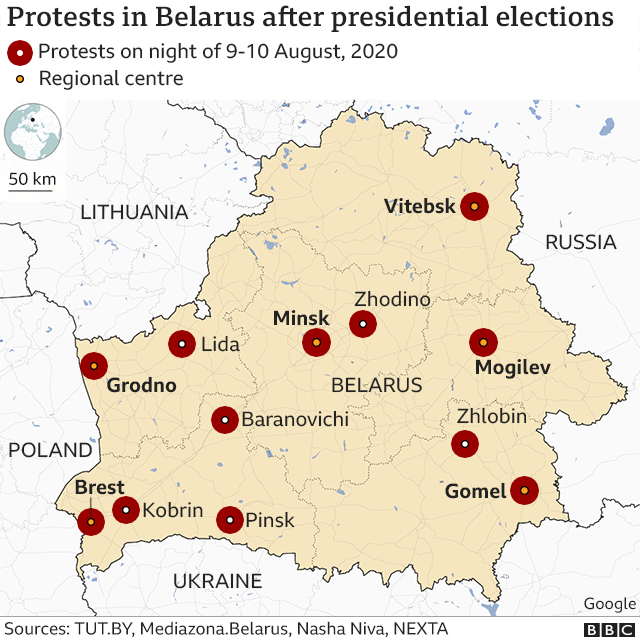
thousands of arrests after protesters and riot police clashed in the capital
Minsk and other cities.
A lack of
scrutiny - no observers were present - has led to widespread fears of
vote-rigging in the poll.
The election
was held amid growing frustration at Mr Lukashenko's leadership, with
opposition rallies attracting large crowds. The preceding days saw a
crackdown on activists and journalists.
The
president has described opposition supporters as "sheep" controlled
from abroad, and vowed not to allow the country to be torn apart
Mr
Lukashenko won 80.23% of the vote, according to a preliminary count, with Ms Tikhanovskaya
receiving 9.9%.
Ms
Tikhanovskaya entered the election in place of her jailed husband and went on
to lead large opposition rallies.
Mr
Lukashenko, 65, has been in power since 1994.
The
opposition candidate said that the election results published on Monday morning
"completely contradict common sense" and the authorities should think
about how to peacefully hand overpower.
"We
have seen that the authorities are trying to hold on to their positions by
force," she said.
"No
matter how much we asked authorities not to turn on their own people, we were
not listened to."
Her campaign
said it would challenge "numerous falsifications" in the vote.
"The
election results announced by the Central Electoral Commission do not
correspond to reality and completely contradict common sense," her
spokeswoman Anna Krasulina said.
But Mr
Lukashenko poured scorn on Ms Tikhanovskaya's comments.
"So
Lukashenko, who is at the top of the power structure and at the head of the
state, after getting 80% of the vote must voluntarily hand over power to
them," the president said. "The orders are coming from over there
[abroad]."
"Our
response will be robust," he added. "We will not allow the country to
be torn apart."
Russian
President Vladimir Putin congratulated his Belarusian counterpart on his victory,
despite friction over accusations of a Russian plot which Mr. Lukashenko
has tried to link to the opposition.
The leaders
of China, Kazakhstan, Uzbekistan, Moldova, and Azerbaijan have sent messages of
support.
But the
German government said it had "strong doubts" about the election and that minimum standards were not met.
European
Commission President Ursula von der Leyen called for the election results to be
published.
"Harassment
and violent repression of peaceful protesters has no place in Europe," she
said.
Meanwhile,
Poland has called for an emergency EU summit to discuss the crisis.
The centre
of Minsk today is quiet but tense. There are a large number of police and
security forces patrolling the streets and lining the main squares, and we saw
several columns of police and military vehicles moving around the city.

One local
told us he had never seen so many police in Minsk. The internet has been
completely blocked here - perhaps even across the country - and with TV being
almost entirely controlled by the state, independent information is difficult
to come by.
But people
are defiant and say they will continue to come on to the streets. Maria
Kolesnikova, a leading opposition figure, told us that they are making a direct
appeal to the police and interior ministry troops to refrain from violence.
Demonstrators
took to the streets in central Minsk as soon as voting ended. Many chanted
"Get out" and other anti-government slogans.
Police used
stun grenades, rubber bullets, and water cannon.
Reports from
a human rights group that a man had died proved to be untrue.
However,
social media footage showed a man who had clung to the front of a police truck
lose his grip as it accelerated, hitting his head.
The interior
ministry said 50 civilians and 39 police were injured.
Three
thousand people were arrested, the ministry added. About one-third of them were
in Minsk, and the rest in other cities such as Brest, Gomel, and Grodno where
similar protests took place.
President
Lukashenko was first elected in 1994.
In the last
vote in 2015, he was declared the winner with 83.5% of the vote. There were no
serious challengers and election observers reported problems in the counting
and tabulation of votes.
The campaign
saw the rise of Ms. Tikhanovskaya, 37, a former teacher who became a
stay-at-home mother until she was thrust into the political spotlight.
After her
husband was arrested and blocked from registering for the vote, she stepped in
to take his place.
President
Lukashenko has dismissed Ms. Tikhanovskaya as a "poor little girl",
manipulated by foreign "puppet masters".
On the eve
of the election, Ms. Tikhanovskaya's team said her campaign manager had been
arrested and would not be released until Monday.
And on
Sunday, as people voted, internet service was "significantly
disrupted", according to online monitor NetBlocks. Opposition supporters
say this makes it harder for evidence of election fraud to be collected and
shared.
There were
already concerns over a lack of scrutiny because observers were not invited to
monitor the election and more than 40% of votes were cast ahead of the
election.
Tens of
thousands defied an escalating crackdown on the opposition last month to attend
a protest in Minsk, the largest such demonstration in a decade.
Anger
towards Mr. Lukashenko's government has been in part fuelled by its response to
coronavirus.
The president has downplayed the outbreak, advising citizens to drink vodka and use
saunas to fight the disease.
Belarus,
which has a population of 9.5 million, has reported nearly 70,000 cases and
almost 600 deaths.
No comments