
Israel and UAE Strike Deal to Normalise Relations
US President
Donald Trump has announced has that Israel and the United Arab Emirates have
agreed to normalise relations.
A joint
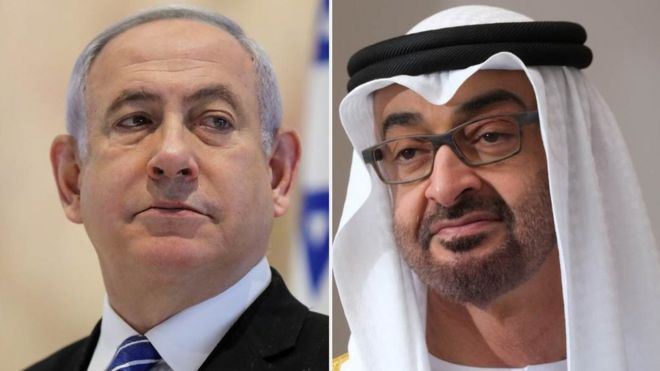
statement by Mr Trump, Israeli PM Benjamin Netanyahu and Abu Dhabi Crown Prince
Mohammed Al Nahyan said they hoped the "historic breakthrough will advance
peace in the Middle East".
As a result,
they added, Israel would suspend its controversial plans to annex parts of the
occupied West Bank.
Until now
Israel has had no diplomatic relations with Gulf Arab countries.
However,
shared concerns over Iran's regional influence have led to unofficial contacts
between them.
In response
to President Trump's announcement, Mr Netanyahu tweeted in Hebrew: "Historic
day."
The UAE's
ambassador to the US, Yousef Al Otaiba, said it was "a win for
diplomacy and for the region".
"It is
a significant advance in Arab-Israeli relations that lowers tensions and
creates new energy for positive change," he added.
But a senior
Palestinian official, Hanan Ashrawi, condemned the deal, saying the UAE had
"come out in the open on its secret dealings/normalisation with
Israel" and telling Prince Mohammed: "May you never be sold out by
your 'friends'."
It marks
only the third Israel-Arab peace deal since Israel's declaration of
independence in 1948. Egypt signed one in 1979, and Jordan in 1994.
In the
coming weeks delegations from Israel and the UAE will meet to sign bilateral
deals regarding investment, tourism, direct flights, security,
telecommunications, technology, energy, healthcare, culture, the environment,
the establishment of reciprocal embassies, and other areas of mutual benefit.
"Opening
direct ties between two of the Middle East's most dynamic societies and
advanced economies will transform the region by spurring economic growth,
enhancing technological innovation, and forging closer people-to-people
relations," the joint statement says.
Israel will
also "suspend declaring sovereignty over areas outlined" in President
Trump's Vision for Peace between Israel and the Palestinians, in which he
backed an Israeli plan to annex Jewish settlements in the West Bank and the
strategic Jordan Valley.
The
Palestinians have warned that such a move would destroy their hopes of a viable
future independent state and violate international law - a stance supported by
much of the international community.
The UAE
Minister of State for Foreign Affairs, Anwar Gargash, said the UAE's
recognition of Israel was "a very bold step" to stop the
"ticking time bomb" of Israel's annexation of the West Bank.
The UAE, he
said, sees this as "a stoppage of the annexation, not a suspension".
Asked about
Palestinian criticism of the UAE move, he recognised that the region was very
polarised and he expected to hear "the usual noise". "We
agonised over this," he said, but eventually decided "let's do
it".
The joint
statement says Israel will "focus its efforts now on expanding ties with
other countries in the Arab and Muslim world", and that the US and UAE
will work to achieve that goal.
The UAE and
Israel will also join the US to launch a "Strategic Agenda for the Middle
East", with the three leaders noting that they "share a similar
outlook regarding the threats and opportunities in the region, as well as a
shared commitment to promoting stability through diplomatic engagement,
increased economic integration, and closer security co-ordination".
The
establishment of full diplomatic relations; the exchange of embassies; and
normal trade ties between Israel and the UAE is a significant diplomatic step
forward. But inevitably it raises questions. Will the full promise of this
agreement be realised? And might other Gulf countries follow a similar path?
It is also
important to see what it is not. This is far from the comprehensive peace plan
to resolve the Palestinian question that President Trump has long promoted.
However, there are short-term benefits for all sides.
The White House
was first off the mark in announcing the deal; it is perhaps a small diplomatic
feather in President Trump's cap at a time when his re-election prospects are
looking more difficult.
For Israel's
embattled Prime Minister Netanyahu, it gets him off a hook of his own making;
his much-vaunted promise to annex key parts of the occupied West Bank. This has
proved undeliverable, not least due to US ambivalence and significant
international opposition. Mr Netanyahu may see this "peace
initiative" with the UAE as something that could bolster his chances if he
precipitates a further Israeli general election.
For the UAE,
it is harder to say precisely what the immediate benefits are, though its
relations with Washington will be strengthened and the deal with Israel may
yield significant economic, security and scientific benefits.
Overall this
is an agreement that potentially could offer both more and less than might
first appear. And as far as the Palestinians are concerned, it is hard to see
this news creating anything other than frustration, that they have once again
been pushed to the sidelines.
No comments