
Israel, UAE in Historic Direct Flight

The first
commercial flight from Israel to the UAE has landed, marking a major step in
normalising relations after the announcement of a peace deal.
The El Al
airliner made the three-hour trip, carrying a delegation of Israeli and US
officials.
The flight
was allowed to cross Saudi Arabian airspace, normally blocked to Israeli air
traffic.
The UAE has
become only the third Arab country in the Middle East to recognise Israel since
its founding in 1948.
On Saturday
the UAE repealed a law boycotting Israel which had been in place since 1972,
and earlier this month the two countries opened direct telephone services for
the first time.
The
agreement to normalise relations - brokered by the US - was made public in a
surprise announcement on 13 August.
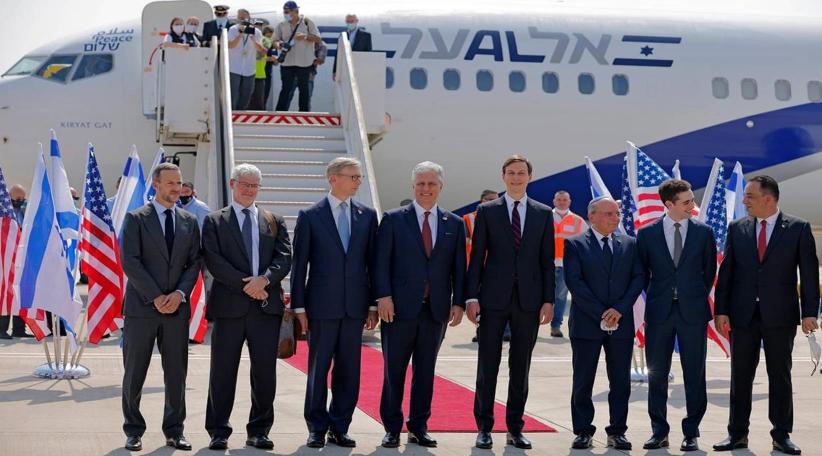
Flight LY971
- numbered to represent the UAE's international dialling code - carried
delegates including Donald Trump's son-in-law and senior adviser Jared Kushner
and Israel's National Security Adviser Meir Ben-Shabbat.
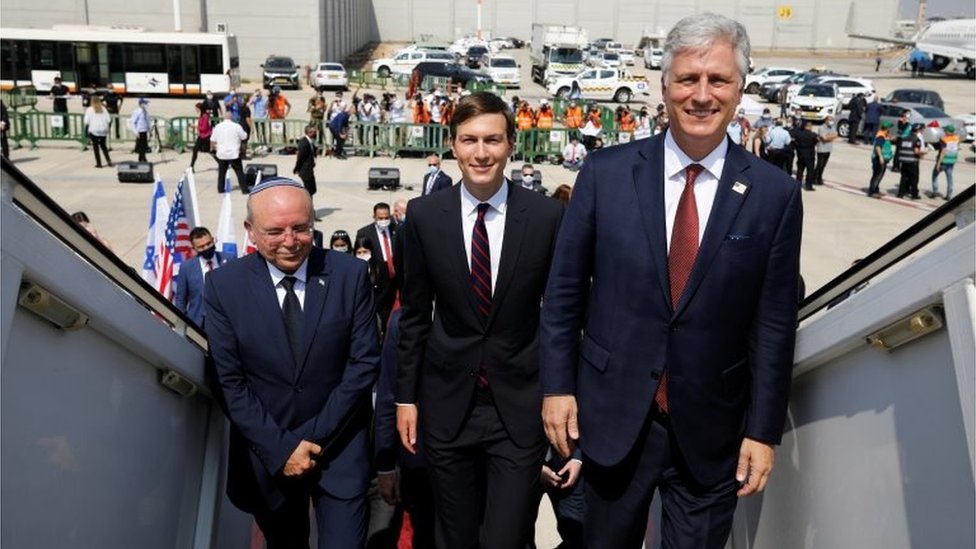
Mr Kushner
led secret talks which resulted in the Israel-UAE agreement.
Speaking to
the media after landing in Abu Dhabi, Mr Kushner described the deal between the
countries as a "historic breakthrough" and said it was a
"tremendous honour" to have joined the flight.
"What
happened here was three great leaders came together and they started writing a
new script for the Middle East. They said the future doesn't have to be
predetermined by the past," he said
The joint
teams will meet Emirati representatives to develop areas of co-operation between
Israel and the UAE. The return flight will be numbered LY972, after Israel's
international dialling code.
Monday's
three-hour flight has taken more than 70 years to make, and it marks a new
turning point in relations between Israel and the Arab world.
There are
big prizes for all three players: Israel's historic need to boost regional
recognition of the Jewish state (could Saudi Arabia one day do so too?); the
Emiratis' glittering finance hubs can benefit from open links with the region's
security and cyber superpower; while a US president under pressure at home gets
to tout his role as peacemaker in the Middle East.
These are
truly significant achievements and further shift the dynamics in a deeply
polarised region. But the deal is striking for another reason - it leaves the
Palestinians feeling as sidelined as ever.
They believe
it breaks years of Arab solidarity - and leverage - against Israel's occupation
of land they want for a future state; while ordinary Palestinians feel more and
more hemmed in as Israeli settler numbers grow.
They see not
only betrayal, but a blind eye being turned by the Emiratis to their reality on
the ground.
In a tweet
in Hebrew, Israeli Prime Minister Benjamin Netanyahu hailed the advent of the
flight as an example of "peace for peace" alluding to his long-held disbelief in the
notion that only trading occupied land will bring peace between Israel and Arab
countries.
While it was
welcomed by much of the international community, the UAE's recognition of
Israel without the precondition of the creation of a Palestinian state was
denounced by the Palestinians as a betrayal of their cause.
In return
for official relations with the UAE, Mr Netanyahu agreed to suspend
controversial plans to annex parts of the occupied West Bank - land claimed by
the Palestinians for a future state of their own.
Mr Kushner
on Monday said his message to Palestinians was "one of hope".
"We've
put an offer to their leadership on the table that will enable them to have a
state and self-determination and an economic plan that could revitalise their
economy, but we can't want peace more than they want peace and so when they are
ready the whole region is very excited to help lift them up and move them
forward but they can't be stuck in the past," he said.
"Peace
will be ready for them and opportunity will be ready for them as soon as
they're ready to embrace it."
A US peace
proposal unveiled in January holds out the prospect of a Palestinian state, as
well as a $50bn (£37.5bn) investment plan for the Palestinians, though the
Palestinians have rejected the proposal as heavily biased towards Israel.
Before the
UAE, Egypt and Jordan were the only other Arab countries in the Middle East to
officially recognise Israel, after signing peace treaties in 1978 and 1994
respectively.
Mauritania,
a member of the Arab League in north-west Africa, established diplomatic
relations with Israel in 1999 but severed ties in 2010.
FROM .bbc.com/news/world-middle-east
No comments