
TikTok Threatens Legal Action Against US Ban
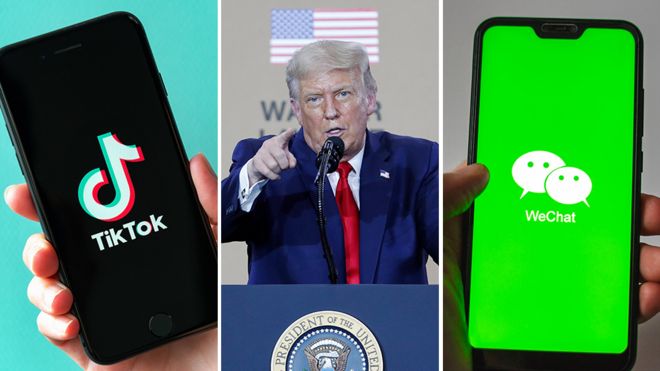
The
company said it was "shocked" by an executive order from the US
President outlining the ban.
TikTok
said it would "pursue all remedies available" to "ensure the
rule of law is not discarded".
Mr
Trump issued a similar order against China's WeChat in a major escalation in
Washington's stand-off with Beijing.
WeChat's
owner, Tencent, said: "We are reviewing the executive order to get a full
understanding."
As well
as WeChat, Tencent is also a leading gaming company and its investments include
a 40% stake in Epic Games - the company behind the
hugely popular Fortnite video game.
The
president has already threatened to ban TikTok in the US, citing national
security concerns, and the company is now in talks to sell its American
business to Microsoft. They have until 15 September to reach a deal - a
deadline set by Mr Trump.
The
Trump administration claims that the Chinese government has access to user
information gathered by TikTok, which the company has denied.
TikTok,
which is owned by China's ByteDance, said it had attempted to engage with the
US government for nearly a year "in good faith".
However,
it said: "What we encountered instead was that the administration paid no
attention to facts, dictated terms of an agreement without going through
standard legal processes, and tried to insert itself into negotiations between
private businesses."
The
executive orders against the short-video sharing platform and the messaging
service WeChat are the latest measure in an increasingly broad Trump
administration campaign against China.
On Thursday,
Washington announced recommendations that Chinese firms listed on US stock
markets should be delisted unless they provided regulators with access to their
audited accounts.
China's
Foreign Ministry on Friday accused the US of using national security as a cover
to exert hegemony.
In both executive
orders, Mr Trump says that the spread in the US of mobile apps developed and
owned by Chinese firms "threaten the national security, foreign policy,
and economy of the United States".
The
US government says TikTok and WeChat "capture vast swaths of information
from its users".
"This
data collection threatens to allow the Chinese Communist Party access to
Americans' personal and proprietary information."
The
executive order also claims both apps gather data on Chinese nationals visiting
the US, allowing Beijing "to keep tabs" on them.
Mr Trump's executive
order also says TikTok's data collection could allow China to track US
government employees and gather personal information for blackmail, or to carry
out corporate espionage.
He
notes that reports indicate TikTok censors content deemed politically
sensitive, such as protests in Hong Kong and China's treatment of the Uighurs,
a Muslim minority.
The
orders have been issued under legal authority from the National Emergencies Act
and the International Emergency Economic Powers Act.
In its most robust
response so far to the US government, TikTok says the executive order that has
been issued is based on "unnamed reports with no citations".
"We
have made clear that TikTok has never shared user data with the Chinese
government, nor censored content at its request," it said.
"We
even expressed our willingness to pursue a full sale of the US business to an
American company."
Mr
Trump said this week he would support the sale to Microsoft as long as the US
government received a "substantial portion" of the sale price.

TikTok said the new
executive order "risks undermining global businesses' trust in the United
States' commitment to the rule of law", adding it sets "a dangerous
precedent for the concept of free expression and open markets".
"We
will pursue all remedies available to us in order to ensure that the rule of
law is not discarded and that our company and our us
The TikTok ban is
hardly a surprise, as the app has faced scrutiny in the US for months. But the
almost identical ban on WeChat is more of a bombshell.
Immediately
after President Trump's executive order was announced, I received a flood of
messages on my WeChat. Friends in America and their loved ones in China were in
an absolute panic.
They
are thousands of miles apart but asking the same question: How are we supposed
to keep in touch after WeChat is banned in the US?
It's
nearly impossible to avoid WeChat for those who have any connections to China.
The
billion-user app is like WhatsApp, Facebook, Instagram, PayPal, Uber, and even
Tinder, all in one ecosystem.
America's
move to block WeChat, a prominent example of China's tech innovation will be
seen as an attack on its culture, its people, and the state. It'll enhance the
popular view in China that Washington is unreasonably suppressing its biggest
competitor in technology.
If
the ban is fully enforced, it'd be a disaster for anyone who has families,
friends or business in China.
While
tit-for-tat has become the new normal in US-China relations, this move will cut
off virtually all people-to-people communication between the world's two most
influential countries.
Mr Trump has been
waging a trade war against China since taking office.
The
US government took action last year against two Chinese communications
companies, Huawei and ZTE, including locking them out of government contracts.
Most
recently, he has blamed the country for the global coronavirus pandemic, which
has crippled the US economy.
Meanwhile,
many of the biggest US platforms - Google, Twitter and Facebook - are banned
inside China.
TikTok
- which has up to 80 million active monthly users in the US - has exploded in
popularity in recent years, mostly with people under 20.
The app is reported
to have around 800 million active monthly users, with its biggest markets
having grown in the US and India.
India
has, however, already blocked TikTok, as well as other Chinese apps.
Australia,
which has already banned Huawei and ZTE, is also considering banning TikTok.
WeChat
is very popular among those users who have connections to China, where major
social networking platforms such as WhatsApp and Facebook are blocked.
It
is also viewed as being a key instrument in China's internal surveillance
apparatus requiring local users who have
been accused of spreading malicious rumours to register a facial scan and voice
print.
A
seminar held earlier this year by the Australian Strategic Policy Institute
think tank discussed how groups within the app would be used to recommend
holiday destinations, restaurants and the like on a day-to-day basis, but then
switch to spreading political messages in line with Beijing's thinking at
critical times
FROM .bbc.com/news/business-
No comments