
Louis van Gaal on His Sacking, His Legacy and Life in Retirement

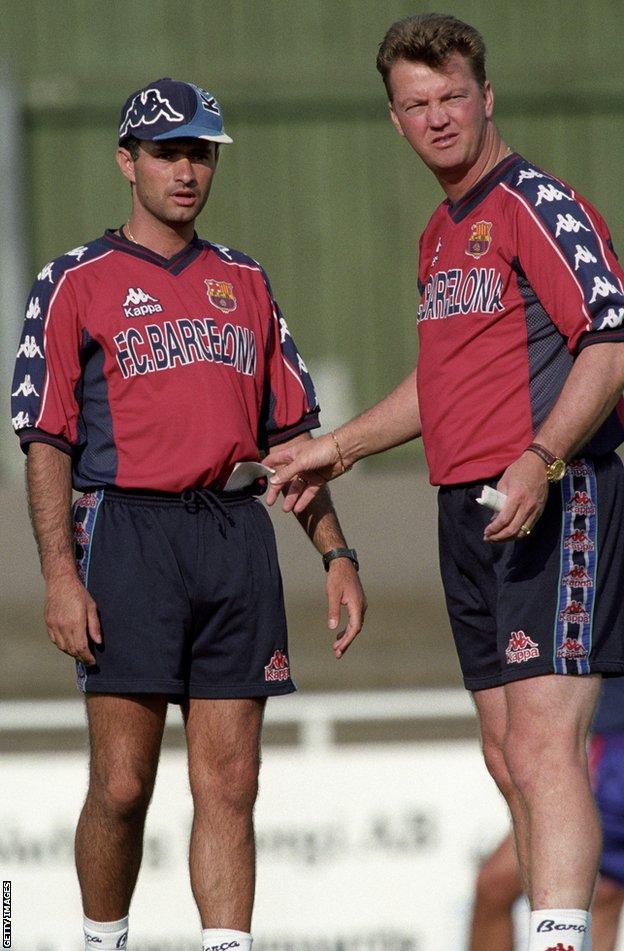 |
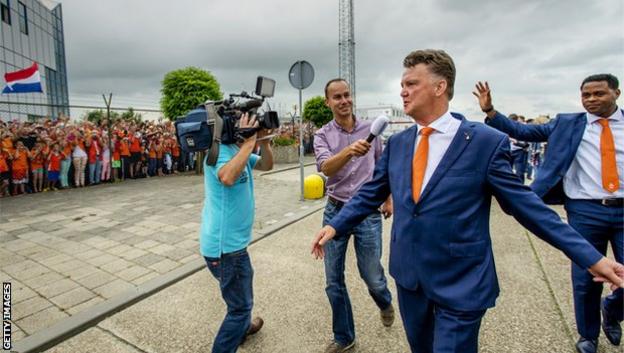
| Van Gaal and Mourinho
It is almost
three years since Louis van Gaal walked into a Wembley news conference and
slammed the FA Cup on to the table.
The Dutchman
had just completed what he regards as his greatest managerial achievement:
"Winning a trophy despite having a noose round my neck for six
months."
Within
minutes of the final whistle of Manchester United's victory with 10 men against
Crystal Palace, it was reported he would be sacked and replaced by Jose
Mourinho.
I met Van
Gaal in Portugal last week for his first written interview with a British
journalist since that day.
He looked
well, energised and now free from the stresses of over four decades in
professional football. The previous week he had confirmed his retirement.
Over the
course of a fascinating 90 minutes, Van Gaal, now 67, was his usual charismatic
self. He laughed - a lot. When he had a specific point to make he would reach
out and give my leg a push, to make sure I was paying attention. If I said
something he disagreed with, he would lean back, scoff and dismiss the remark
with a wave.
Every so
often he would finish an answer with a question that demanded a response to the
specific point he had made. He asked, more than once, for me to tidy up his
sentences because his English "is not so good". He broke off the
interview to pose for a photograph with a fan, but not before asking me if it
was OK. Van Gaal places huge importance on attention to detail in his personal
relationships.
It was clear
the manner of his exit from Manchester United still rankles. To get to the crux
of his resentment, wind back to the spring of 2014.
United were
trying to pick their way out of the disaster created by the decision to appoint
David Moyes as Sir Alex Ferguson's successor.
They wanted
someone with a track record of success who would not be overwhelmed by the job.
Van Gaal fitted the bill. Moreover, he was available as his contract with the
Netherlands would expire after the World Cup. Tottenham were also interested,
but United's pulling power was persuasive.
"Tottenham
were a better selection because Manchester United were an old team and I knew I
would have to transform them," Van Gaal says. "Was it the wrong
choice? Maybe, but I follow my heart. I worked at the number one team in the
Netherlands, Germany, Spain and now also in England."
Van Gaal
wanted a two-year contract. It would take him to the summer of 2016 and fulfil
a pledge he made to his mother during his younger days that he would retire
when he was 65. United wanted him to commit for three.
He says:
"The Glazers [the club's owners] and Ed Woodward [executive vice-chairman]
asked me. That is why I am still angry with the way they chose to do it. Ed
Woodward knew Manchester United would be my last club."
Van Gaal was
also aware restoring the club to its former glories was not going to be a
speedy process.
"They
had seven players over 30," he says. "We spoke about that at the job
interview. In my first year we qualified for the Champions League. In my second
we won the FA Cup."
On 21
November in that second season, United won 2-1 at Watford. They were second in
the Premier League, a point behind eventual champions Leicester. Their next
five games yielded two points in a disastrous period during which they were
also eliminated from the Champions League.
As supporter
disenchantment with perceived negative football grew, Van Gaal's position as
manager came under increasing scrutiny. Without Van Gaal's knowledge, contact
was made with Mourinho. To this day, United are adamant no job offer was made.
Alternative sources from outside Old Trafford said otherwise, the media ran
with it and Van Gaal found himself in an impossible situation.
"I can
imagine Woodward chooses Mourinho," says Van Gaal. "He is a top
coach. He has won a lot of titles. More than me.
"What I
don't like is Woodward contacting my successor, knowing in his mind he will
replace me and he keeps his mouth shut for six months. Every Friday I had to go
into press conferences and be asked what I thought about the rumours. What does
that do to the authority of the coach?
"To win
the FA Cup when, for six months, the media has a noose round my neck, is my
biggest achievement.
"I
spoke to Woodward the day after that game. His argument was that I was only
going to be there for one more year and Mourinho would be there for three, four
or five. I appreciate he hired a private plane to get me back to Portugal but
his arguments were not good enough."
Van Gaal
gets animated when the negative view of his football is pointed out.
"It is
not true," he argues. "You say it was boring. Why was it boring?
Maybe it was boring-attacking but that was because the opponent parked the bus.
Then you have to play at a higher tempo, which is difficult. Then you have to
see what kind of players you have.
"Wayne
Rooney should have been the number 10 but Robin van Persie was not fit enough
for the Premier League, which meant Rooney was the best striker we had. But
Manchester United needs the best striker in the world."
He tried to
address the problem.
In came
Angel di Maria, Radamel Falcao and Bastian Schweinsteiger. Huge names at huge
expense.
The first
two lasted a single season, Schweinsteiger made four appearances in his second
before moving to Major League Soccer in March 2017.
Di Maria
recently blamed Van Gaal for his United failure because he picked him in the
wrong positions.
"Di
Maria says it was my problem. I played him in every attacking position. You can
check that. He never convinced me in any of those positions. He could not deal
with the continuous pressure on the ball in the Premier League. That was his
problem," says Van Gaal.
"I
brought Schweinsteiger in because we needed a captain on the pitch. He didn't
do it. He was injured. He had an excuse.
"I
wanted a first-class striker. I don't want to go through all the names but when
you can't have the first or second choice, you have to be happy with the fourth
or fifth, so Falcao came into the picture but we knew in advance he was
injured. That is why I said we should take him on loan."
Over the
course of our conversation, Van Gaal returns to a theme.
The media
has power to influence but they do so on a very limited amount of facts.
As an
example he explains how Ajax were lucky to beat Real Madrid in the Champions
League earlier this month and why, despite losing at the Amsterdam Arena, they
were much better at home in the first leg than they were in the second, which
is considered one of the great modern-day performances by a Dutch team.
"The
media do not analyse the game," he says. "They analyse the
result."
Which brings
us to Ole Gunnar Solskjaer.
"People
think we have only had fake news since Donald Trump became president. In
football we have had it for 50 years," says Van Gaal.
"The
coach after me [Mourinho] changed to park-the-bus tactics and played on the
counter. Now there is another coach who parks the bus and plays on the counter.
The main difference between Mourinho and Solskjaer is that Solskjaer is
winning.
"I am
not there but there does look to be a change and the atmosphere seems to be
better. It is also true that Solskjaer has changed Paul Pogba's position and
put him into an area where he is much more important.
"But
the way Manchester United are playing now is not the way Ferguson played. It is
defensive, counter-attacking football. If you like it, you like it. If you
think it is more exciting than my boring attacking, OK. But it is not my truth.
"Solskjaer
has just lost twice and he has to manage that. It is very important that
Manchester United qualifies for the Champions League, as it was when I was
manager. But they can also win the Champions League because they play a
defensive system and it is very difficult to beat them, which, whether you like
it or not, is the result of Mourinho's work."
The previous
day Van Gaal gave a talk to a League Managers' Association meeting and he
remains hugely sensitive to the difficulties all managers face.
He has
opinions, lots of them, but at no point, either on or off the record, is he
critical of anyone who puts themselves forward for the job. Although he has
noticed how quickly one of his major critics decided he had himself taken a
wrong move recently, 31 days after his appointment by Oldham.
"Paul
Scholes was a manager too, yes?" he smiles. "Fantastic, eh.
Fantastic."
Van Gaal is
amused at "being retired by the media" as he says his recent comments
only repeated something he said first in 2012. Yet he also reveals he received
two job offers a month after leaving United. Not all of them were dismissed out
of hand.
"They were
from the highest level," he says. "Not too much from England but a
lot in Germany, Spain, USA, Mexico, Argentina. I had big doubts twice. I asked
my wife, Truus, but she said no. The last one was Feyenoord. She wanted to do
that because she is a Feyenoord fan but I am a consistent man."
There is a
public perception of Van Gaal that he enjoys being the centre of attention. He
says this is misplaced. How long, he asks, have I been asking him for an
interview?
The answer
is about once a month since his United exit. If he was addicted to attention,
he argues, why would he wait so long?
"Everybody
thinks I am a narcissist. I am actually the opposite of that," he
chuckles.
"The
media likes me because I give honest answers. How many people in football give
honest answers? I don't lie. Always the truth. OK, maybe my truth. But it is
the truth."
In the
aftermath of Mourinho's exit, United sources stated clearly the appointment of
a technical director was on the agenda, in addition to a new manager.
At present,
nothing has changed from Van Gaal's time, with Woodward in overall charge and
Matt Judge, who has a masters degree in economics and finance and 13 years'
experience in investment banking, negotiating fees and contracts. United are
adamant their priority is the football side and success on pitch is the
objective for everyone at the club. Van Gaal does not agree.
"At the
moment there is a structure with a scouting division and above that is someone
at Woodward's right hand. The structure is not so bad but the right hand has to
be a technical director with a football view, not somebody with a banker's
role," Van Gaal says.
"Unfortunately,
we are talking about a commercial club, not a football club. I spoke to
Ferguson about this and in his last years, he also had problems with it."
If there is
one aspect of Van Gaal's illustrious career for which he will be remembered,
beyond the trophies, it is the number of young players he picked.
Van Gaal
gave debuts to Clarence Seedorf, Patrick Kluivert, Edwin van der Sar, Carles
Puyol, Xavi, Andres Iniesta, Thomas Muller, all now established names at
football's highest level. There are many, many more, including Marcus Rashford
from his time at United.
He says:
"I read something from Mourinho saying I only did that out of necessity.
Not true. I created the necessity.
"Manchester
United had over 30 players. I brought them back to 23. Then I had an open
selection for the youth academy. I did that at every club. That is why a lot of
young players have made their debuts with me.
"A lot
of trainers, like Mourinho, never give youngsters a chance. Yes, five minutes.
Solskjaer, 10 minutes. That is not a chance. A chance is a game.
"Too
much experience is not good. Then you have an automatic pilot. You always need
imagination and you cannot forget how inspiring young players can be.
"If you
are not willing to trust young players, you are not suitable to be a manager of
a club with a youth education."
But the
journey to the top is not exclusively to do with ability.
"Your
personality is also very important. In my time, Rashford was very modest and I
thought he would reach the higher level," Van Gaal says.
"I knew
players with the highest ability to kick a ball from A to B but as a human
being, no. Then you can forget it."
There are
eight teams left in the Champions League. Van Gaal managed three of them -
Ajax, Barcelona and United. He knows United fans in particular will be annoyed
at his preferred outcome.
"People
think Barcelona are the best but they are not. Manchester City and Liverpool
are more of a team than Barcelona - and Liverpool are more of a team than
City," he says.
"In my
philosophy the best team shall win but I hope for City because they play the
best football."
After 46
years, Van Gaal's active career in football is over. Now he is creating
"my own future", with his wife, his children and grandchildren. A
house move on the Algarve is nearing its final stages.
Pushed to
assess his legacy, Van Gaal reveals a softer side, which, he feels, is a more
accurate reflection of the man he really is.
"I have
a philosophy. I was convinced of it and by winning trophies in four countries,
I proved the philosophy worked," he says.
"But my
legacy is bigger than just my results. I am also a relations coach, not only
with my players but everyone in a club.
"It is
not my image but I am very human in that way. At Manchester United there were
more than 40 people in the performance department. The medical department, the
fans. They all had a heart for the club. I went to work as an analyst at a game
at Liverpool and the United fans were still shouting my name.
"I am
proud people still like me. That is what is most important in life. "
FROM .bbc.com/sport/football
|
No comments