
Norway Museum to Return Chile’s Easter Island Artefacts
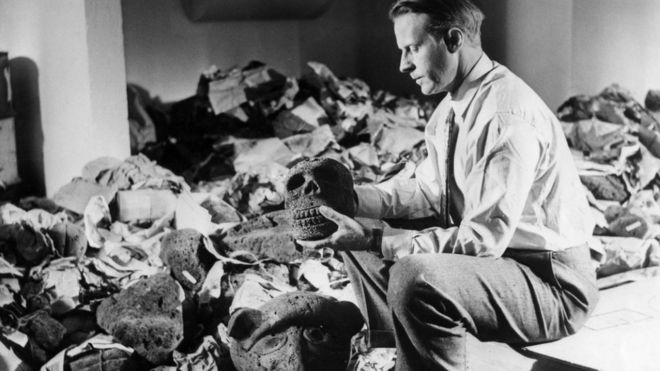
Norway has
agreed to return thousands of artefacts taken from Chile's Easter Island by
renowned Norwegian explorer Thor Heyerdahl in 1956.
The
agreement was signed by his son on behalf of Oslo's Kon-Tiki museum and Chile's
culture ministry in Santiago.
The
artefacts include carved pieces and human bones from the Pacific island.
In 1947,
Heyerdahl became famous for skippering a tiny balsawood raft, the Kon-Tiki, on
a 6,000km (3,728 miles) journey from Peru to Polynesia.
His
expedition proved, he said, that ancient cultures could have sailed to, and
populated, the South Pacific.
Later DNA
tests suggested that the islands were settled by migrant populations from South
East Asia.
Heyerdahl
subsequently made a number of voyages around the world, including his
expeditions to Easter Island (or Rapa Nui) in 1955-56 and again in 1986-88.
Heyerdahl
conducted the first co-ordinated excavations on the abandoned island whose many
carved heads stand guard over the Pacific.
The explorer
and ethnographer died in 2002, aged 87.
It was signed
in Chile's National Library in Santiago.
Heyerdahl's
son, Thor Heyerdahl Jr, says "the repatriation is a fulfilment of my
father's promise to the Rapa Nui authorities that the objects would be returned
after they had been analysed and published", he is quoted as saying by the
AFP news agency.
Kon-Tiki
museum director Martin Biehl said "our common interest is that the objects
are returned and, above all, delivered to a well-equipped museum".
The whole
process "will take time", he said, without giving any further
details.
After the
signing ceremony, Chilean Culture Minister Consuelo Valdes stressed that
"as a ministry we have the mission to respond to the just demand of the
Rapa Nui people to recover their cultural heritage".
Chile is
also demanding that London's British Museum return the figure of Hoa Hakananai,
an imposing basalt statue from Easter Island.
Such
statues, known as moai, were carved by the island's indigenous Rapa Nui people
to embody the spirit of a prominent ancestor, with each considered to be the
person's living incarnation.
FROM .bbc.com/news/world-europe
No comments