
First Ever Black Hole Image Released
Astronomers
have taken the first ever image of a black hole, which is located in a distant
galaxy.
It measures
40 billion km across - three million times the size of the Earth - and has been
described by scientists as "a monster".
The black
hole is 500 million trillion km away and was photographed by a network of eight
telescopes across the world.
Details have
been published today in Astrophysical Journal Letters.
Prof Heino
Falcke, of Radboud University in the Netherlands, who proposed the experiment,
told BBC News that the black hole was found in a galaxy called M87.
"What
we see is larger than the size of our entire Solar System," he said.
"It has
a mass 6.5 billion times that of the Sun. And it is one of the heaviest black
holes that we think exists. It is an absolute monster, the heavyweight champion
of black holes in the Universe."
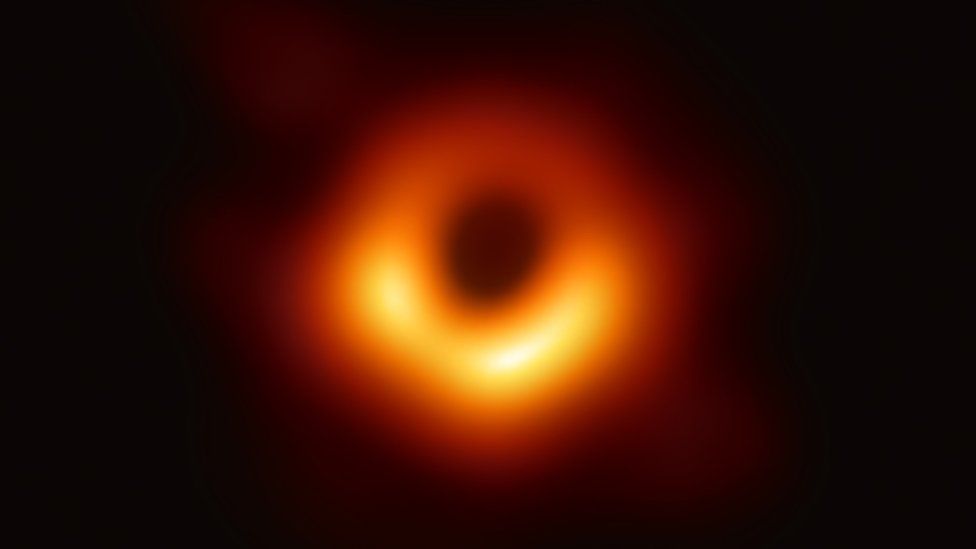
The image
shows an intensely bright "ring of fire", as Prof Falcke describes
it, surrounding a perfectly circular dark hole. The bright halo is caused by
superheated gas falling into the hole. The light is brighter than all the
billions of other stars in the galaxy combined - which is why it can be seen at
such distance from Earth.
The edge of
the dark circle at the centre is the point at which the gas enters the black
hole, which is an object that has such a large gravitational pull, not even
light can escape.
The image matches
what theoretical physicists and indeed, Hollywood directors, imagined black
holes would look like, according to Dr Ziri Younsi, of University College
London - who is part of the collaboration.
"Although
they are relatively simple objects, black holes raise some of the most complex
questions about the nature of space and time, and ultimately of our
existence," he said.
"It is
remarkable that the image we observe is so similar to that which we obtain from
our theoretical calculations. So far, it looks like Einstein is correct once
again."
But having
the first image will enable researchers to learn more about these mysterious
objects. They will be keen to look out for ways in which the black hole departs
from what's expected in physics. No-one really knows how the bright ring around
the hole is created. Even more intriguing is the question of what happens when
an object falls into a black hole.
 What
is a black hole?
What
is a black hole?
A black hole
is a region of space from which nothing, not even light, can escape
Despite the
name, they are not empty but instead consist of a huge amount of matter packed
densely into a small area, giving it an immense gravitational pull
There is a
region of space beyond the black hole called the event horizon. This is a
"point of no return", beyond which it is impossible to escape the
gravitational effects of the black hole
Prof Falcke
had the idea for the project when he was a PhD student in 1993. At the time,
no-one thought it was possible. But he was the first to realise that a certain
type of radio emission would be generated close to and all around the black
hole, which would be powerful enough to be detected by telescopes on Earth.
He also
recalled reading a scientific paper from 1973 that suggested that because of
their enormous gravity, black holes appear 2.5 times larger than they actually
are.
These two
previously unknown factors suddenly made the seemingly impossible, possible.
After arguing his case for 20 years, Prof Falcke persuaded the European
Research Council to fund the project. The National Science Foundation and
agencies in East Asia then joined in to bankroll the project to the tune of
more than £40m.
It is an
investment that has been vindicated with the publication of the image. Prof
Falcke told me that he felt that "it's mission accomplished".
He said:
"It has been a long journey, but this is what I wanted to see with my own
eyes. I wanted to know is this real?"
No single telescope
is powerful enough to image the black hole. So, in the biggest experiment of
its kind, Prof Sheperd Doeleman of the Harvard-Smithsonian Centre for
Astrophysics, led a project to set up a network of eight linked telescopes.
Together, they form the Event Horizon Telescope and can be thought of as a
planet-sized array of dishes.
Each is
located high up at a variety of exotic sites, including on volcanoes in Hawaii
and Mexico, mountains in Arizona and the Spanish Sierra Nevada, in the Atacama
Desert of Chile, and in Antarctica.
A team of
200 scientists pointed the networked telescopes towards M87 and scanned its
heart over a period of 10 days.
The
information they gathered was too much to be sent across the internet. Instead,
the data was stored on hundreds of hard drives that were flown to a central
processing centres in Boston, US, and Bonn, Germany, to assemble the
information. Prof Doeleman described the achievement as "an extraordinary
scientific feat".
"We
have achieved something presumed to be impossible just a generation ago,"
he said.
"Breakthroughs
in technology, connections between the world's best radio observatories, and
innovative algorithms all came together to open an entirely new window on black
holes."
The team is
also imaging the supermassive black hole at the centre of our own galaxy, the
Milky Way.
Odd though
it may sound, that is harder than getting an image from a distant galaxy 55
million light-years away. This is because, for some unknown reason, the
"ring of fire" around the black hole at the heart of the Milky Way is
smaller and dimmer.
FROM .bbc.com/news/science-environment-
No comments