
Wikileaks Co-Founder Julian Assange Arrested in London
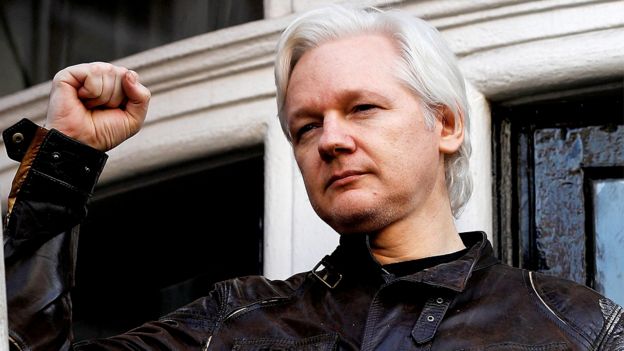
Wikileaks
co-founder Julian Assange has been arrested at the Ecuadorian embassy in
London.
Assange took
refuge in the embassy in 2012 to avoid extradition to Sweden over a sexual
assault case that has since been dropped.
At
Westminster Magistrates' Court on Thursday he was found guilty of failing to
surrender to the court.
He now faces
US federal conspiracy charges related to one of the largest ever leaks of
government secrets.
The UK will
decide whether to extradite Assange, in response to allegations by the
Department for Justice that he conspired with former US intelligence analyst
Chelsea Manning to download classified databases.
He faces up
to five years in US prison if convicted on the charges of conspiracy to commit
computer intrusion.
Assange's
lawyer Jennifer Robinson said they would be fighting the extradition request.
She said it set a "dangerous precedent" where any journalist could
face US charges for "publishing truthful information about the United
States".
She said she
had visited Assange in the police cells where he thanked supporters and said:
"I told you so."
Assange had
predicted that he would face extradition to the US if he left the embassy.
After his
arrest, the 47-year-old Australian national was initially taken to a central
London police station before appearing in court.
Dressed in a
black suit and black polo shirt, he waved to the public gallery and gave a
thumbs up. He pleaded not guilty to the 2012 charge of failing to surrender to
the court.
Finding him
guilty of that charge, District Judge Michael Snow said Assange's behaviour was
"the behaviour of a narcissist who cannot get beyond his own selfish
interest".
He sent him
to Southwark Crown Court for sentencing, where he faces up to 12 months in
prison.
The court
also heard that during his arrest at the embassy he had to be restrained and
shouted: "This is unlawful, I am not leaving."
Assange set
up Wikileaks in 2006 with the aim of obtaining and publishing confidential
documents and images.
The
organisation hit the headlines four years later when it released footage of US
soldiers killing civilians from a helicopter in Iraq.
Former US
intelligence analyst Chelsea Manning was arrested in 2010 for disclosing more
than 700,000 confidential documents, videos and diplomatic cables to the
anti-secrecy website.
She said she
only did so to spark debates about foreign policy, but US officials said the
leak put lives at risk.
She was
found guilty by a court martial in 2013 of charges including espionage.
However, her jail sentence was later commuted.
Manning was
recently jailed for refusing to testify before an investigation into
Wikileaks' role in revealing the secret files.
The
indictment against Assange, issued last year in the state of Virginia, alleges
that he conspired in 2010 with Manning to access classified information on
Department of Defense computers. He faces up to five years in jail.
Manning
downloaded four databases from US departments and agencies between January and
May 2010, the indictment says. This information, much of which was classified,
was provided to Wikileaks.
The US
Justice Department described it as "one of the largest compromises of
classified information in the history of the United States".
Cracking a
password stored on the computers, the indictment alleges, would have allowed
Manning to log on to them in such a way as to make it harder for investigators
to determine the source of the disclosures. It is unclear whether the password
was actually broken.
Correspondents
say the narrowness of the charge seems intended to avoid falling foul of the US
Constitution's First Amendment guarantee of freedom of the press.
The
Wikileaks co-founder had been in the Ecuadorian embassy in London since 2012,
after seeking asylum there to avoid extradition to Sweden on a rape allegation.
The
investigation into the alleged rape, which he denied, was later dropped because
he had evaded the arrest warrant. The Swedish Prosecution Authority has said it
is now considering whether to resume the inquiry before the statute of
limitations runs out in August 2020.
Scotland
Yard said it was invited into the embassy on Thursday by the ambassador,
following the Ecuadorian government's withdrawal of asylum.
Ecuadorian
president Lenin Moreno said the country had "reached its limit on the
behaviour of Mr Assange".
Mr Moreno
said: "The most recent incident occurred in January 2019, when Wikileaks
leaked Vatican documents.
"This
and other publications have confirmed the world's suspicion that Mr Assange is
still linked to WikiLeaks and therefore involved in interfering in internal
affairs of other states."
His
accusations against Assange also included blocking security cameras at the
embassy, accessing security files and confronting guards.
Mr Moreno
said the British government had confirmed in writing that Assange "would
not be extradited to a country where he could face torture or the death
penalty".
The arrest
comes a day after Wikileaks said it had uncovered an extensive spying operation
against its co-founder at the Ecuadorian embassy.
There has
been a long-running dispute between the Ecuadorian authorities and Assange
about what he was and was not allowed to do in the embassy.
BBC
diplomatic correspondent James Landale said that over the years they had
removed his access to the internet and accused him of engaging in political
activities - which is not allowed when claiming asylum.
He said:
"Precisely what has happened in the embassy is not clear - there has been
claim and counter claim."
Prime Minister
Theresa May told the House of Commons: "This goes to show that in the UK,
no one is above the law."
Foreign
Secretary Jeremy Hunt said the arrest was the result of "years of careful
diplomacy" and that it was "not acceptable" for someone to
"escape facing justice".
But Labour's
shadow home secretary Diane Abbott said Assange was being pursued for
"whistle-blowing into illegal wars, mass murder, murder of civilians and
corruption on a grand scale" that put him "in the cross-hairs of the
US administration".
Press
freedom organisation Reporters Without Borders said that the UK should resist
extradition, because it would "set a dangerous precedent for journalists,
whistleblowers, and other journalistic sources that the US may wish to pursue
in the future".
Australia's
Foreign Minister Marise Payne said he would continue to receive "the usual
consular support" and that consular officers will try to visit him.
And actress
Pamela Anderson, who has visited the embassy to support Assange, said the
arrest was a "vile injustice".
Timeline:
Julian Assange saga
August
2010 - The Swedish Prosecutor's Office first issues an arrest warrant for
Assange. It says there are two separate allegations - one of rape and one of
molestation. Assange says the claims are "without basis"
December
2010 - Assange is arrested in London and bailed at the second attempt
May
2012 - The UK's Supreme Court rules he should be extradited to Sweden to
face questioning over the allegations
June
2012 - Assange enters the Ecuadorean embassy in London
August
2012 - Ecuador grants asylum to Assange, saying there are fears his human
rights might be violated if he is extradited
August
2015 - Swedish prosecutors drop their investigation into two allegations -
one of sexual molestation and one of unlawful coercion because they have run
out of time to question him. But he still faces the more serious accusation of
rape.
October
2015 - Metropolitan Police announces that officers will no longer be
stationed outside the Ecuadorean embassy
February
2016 - A UN panel rules that Assange has been "arbitrarily
detained" by UK and Swedish authorities since 2010
May
2017 - Sweden's director of public prosecutions announces that the rape investigation
into Assange is being dropped
July
2018 - The UK and Ecuador confirm they are holding ongoing talks over the
fate of Assange
October
2018 - Assange is given a set of house rules at the Ecuadorean embassy in
London. He then launches legal action against the government of Ecuador
December
2018 - Assange's lawyer rejects an agreement announced by Ecuador's
president to see him leave the Ecuadorean embassy
February
2019 - Australia grants Assange a new passport amid fears Ecuador may
bring his asylum to an end
April
2019 - The Metropolitan Police arrests him for "failing to surrender
to the court" over a warrant issued in 2012. He is found guilty and faces
up to 12 months in prison, as well as extradition over US charges of conspiracy
to commit computer intrusion.
FROM .bbc.com/news/uk-
No comments