
Colombia Ex-Farc Rebel Iván Márquez Issues Call to Arms
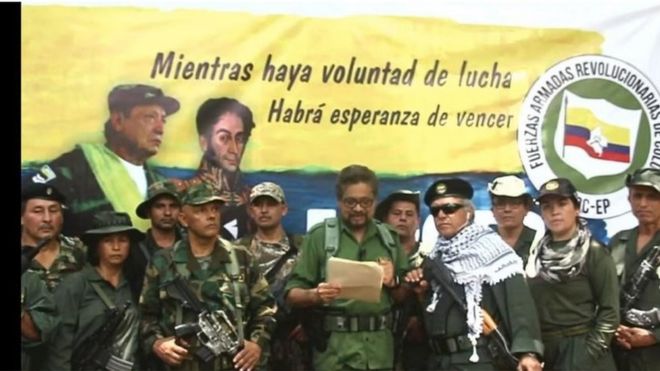
Iván
Márquez appeared in a video and announced that a "new phase of the armed
struggle" was beginning.
He
was one of the main negotiators of the peace deal in 2016.
The
Colombian government said it was "a very worrying announcement".
It shows Iván
Márquez reading out a statement in front of a banner saying "While there
is a will to fight, there'll be hope of winning".
He is surrounded by
about a dozen men and women dressed in camouflage. Among them are two other
senior former Farc rebels, Jesús Santrich, and the man known as El Paisa.
In
his 30-minute-long statement, Iván Márquez says that he called for a return to
arms because the Colombian state had "betrayed" the peace agreement
he helped negotiate.
The Farc's
decades-long armed struggle
1964: Set up as armed wing of Communist Party
2002: At its height, it
has an army of 20,000 fighters controlling up to a third of the country
2008: The Farc suffers a
series of defeats in its worst year
2012: Start of peace
talks in Havana
2016: Peace deal
signed in November
2017: Farc officially
ceases to be an armed group
2019: Former
commander Iván Márquez announces "a new phase of the armed struggle"
"In two years,
more than 500 social leaders have been killed and 150 guerrilla fighters are
dead amidst the indifference and the indolence of the state," Iván Márquez
says, referring to the high number of activists and former Farc members killed
since President Iván Duque took up office.
In the recording, he
also says that the new guerrilla group, which carries the old name, Farc-EP
(Revolutionary Armed Forces of Colombia - People's Army), will pursue different
tactics.
He says that the
group will only "respond to offensives" and that they will not carry
out kidnappings for ransom but instead "seek dialogue" with local
landowners and business people to try and convince them to
"contribute" to their cause.
The
video ends with Jesús Santrich shouting "Long live the Farc-EP!"
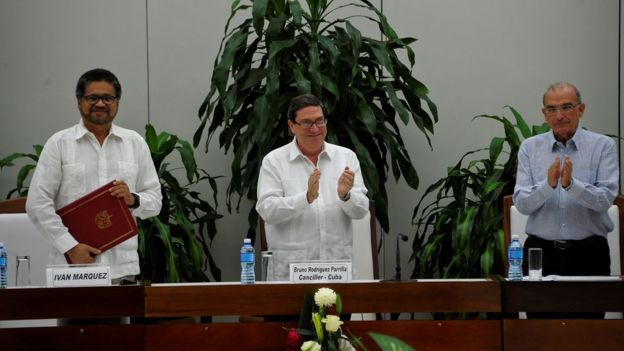
Iván Márquez is the
nom-de guerre of Luciano Marín Arango. He was the number two in the Farc rebel
movement before the guerrilla group signed a peace deal with the Colombian
government in 2016, after more than five decades of armed conflict.
He was a key figure
in the peace negotiation which led to the signing of a peace deal in November
2016, leading the Farc negotiating team for the four years the talks lasted.
As
part of the peace process, the Farc turned into a political party and was
assigned a number of seats in Colombia's congress.
Iván
Márquez was assigned one of the Farc's five seats in the senate. But days
before he was due to take up his post in July 2018, he announced he would not
do so in protest at the arrest of his Farc comrade, Jesús Santrich.
He
went into hiding shortly afterwards and his only public appearance was in a
video released in January.
In
that video, he accused the Colombian government of failing to implement the
agreements reached with the Farc and said he felt "disheartened". But
at the time, he said he was still committed to peace.
A little before
Christmas 2015, I sat down in Havana with Iván Márquez. One of the top Farc
commanders and a chief negotiator in the peace process with the Colombian
Government, he repeated his firm conviction that the decades of violence had
been worth it to bring Colombia to the brink of peace.
"If
we hadn't been here to fight for what we believe in, who knows what would have
happened to Colombia. Probably the complete looting of our natural
resources," he told me.
I
remember, though, that he also expressed concern that the Colombian government
would be true to its word. If necessary, he said, he would always be ready to
pick up arms again. It was a sentiment echoed by almost all the Farc guerrillas
I met in Cuba at that time and on a subsequent visit to one of their jungle
camps in Colombia.
Considered
an ideologue, even by the radical standards of the Farc, it doesn't come as an
entire surprise that Iván Márquez is now the one to issue the rallying cry to
the guerrillas to return to the jungle. He had often said that the commitment
to the peace deal was real but conditional on the Colombia government sticking
rigidly to the terms of the deal.
From
his perspective - one of a life spent in near-constant conflict - they have
broken that binding pact. So in return, he has broken with civilian life and
picked up the gun once more. For Colombia, the omens of that decision are
profoundly worrying.
It has been clear
since he gave up his senate seat and went into hiding last year that Iván
Márquez's commitment to the peace deal was wavering.
The
same applies to Jesús Santrich, a former Farc rebel turned Congressman who
failed to show up to court over drug smuggling charges in July.
FROM .bbc.com/news/world-latin-america-
No comments