
House Votes to Formalise Trump Impeachment Inquiry
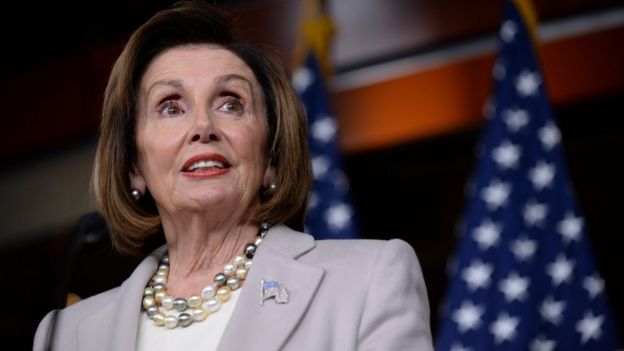 |
| House Speaker Nancy Pelosi announced the impeachment inquiry last month |
The US House
of Representatives has passed a resolution to formally proceed with the
impeachment inquiry against President Donald Trump.
The measure
details how the inquiry will move into a more public phase. It was not a vote
on whether the president should be removed from office.
This was the
first test of support in the Democratic-controlled House for the impeachment
process.
The White
House condemned the vote, which passed along party lines.
Only two
Democrats - representing districts that Mr Trump won handily in 2016 - voted
against the resolution, along with all Republicans, for a total count of 232 in
favour and 196 against.
The
resolution also sets out due process rights for Mr Trump's lawyers under the
congressional inquiry.
The
Republican president is accused of trying to pressure Ukraine into
investigating unsubstantiated corruption claims against his political rival,
Joe Biden, and his son who worked with Ukrainian gas company Burisma.
Mr Trump
denies wrongdoing.
Republicans
have criticised Democrats for the closed hearings - in which Republican
lawmakers have also taken part. But Democrats insist they were needed to gather
evidence ahead of the public stage of the investigation, and deny allegations
they have been secretive.
The
resolution moves the inquiry to a new phase, which could eventually see
articles of impeachment recommended against Mr Trump. If that happened, and the
House voted to pass the articles, a trial would be held in the Senate.
Republicans
have been clamouring for weeks for the Democrats to hold a full vote that will
formalise the impeachment inquiry in the House of Representatives. Now they got
one.
It won't
alter the dynamic in Washington, however.
Republicans
will continue to object to what they see as an unfair process with a
preordained result. Democrats will push ahead with an investigation that they
always intended would culminate in dramatic public hearings and (perhaps) an
impeachment vote.
This doesn't
mean that Thursday's proceedings are meaningless, however. For the first time
since 1998, the House is taking a significant step toward impeaching a
president.
The
resolution gives the public some idea what to expect in the days ahead -
including lots of Intelligence Committee sparring between Democrats and
Republicans, a look at the transcripts from some of the high-profile witness
depositions already conducted and, at some point, a formal report that could
serve as the basis of articles of impeachment.
It's not
exactly uncharted territory in US history, but the course being set leads
toward a historic clash with the presidency at stake.
In the first
stage, the House Intelligence Committee will hold public hearings in the coming
weeks. It will have the right to make public transcripts of depositions taken
in private.
In the
second stage, a public report on the findings will be sent to the House
Judiciary Committee which will conduct its own proceedings and report on
"such resolutions, articles of impeachment, or other recommendations as it
deems proper".
President
Trump's lawyers will be allowed to take part in the Judiciary Committee stage.
Republicans
will be able to subpoena documents or witnesses although they could still be
blocked as both panels are controlled by Democrats.
House
Speaker Nancy Pelosi, who is the most senior elected Democrat, said the
procedures would allow lawmakers to decide whether to impeach Trump "based
on the truth".
"I
don't know why the Republicans are afraid of the truth," she added.
But House Republican
leader Kevin McCarthy argued that Democrats are trying to remove Trump
"because they are scared they cannot defeat him at the ballot box" in
next year's presidential election.
White House
press secretary Stephanie Grisham said in a statement: "Speaker Pelosi and
the Democrats have done nothing more than enshrine unacceptable violations of
due process into House rules."
At the heart
of the investigation, which was announced by Mrs Pelosi last month, is a phone
call on 25 July between Mr Trump and Ukrainian President Volodymyr Zelensky.
A rough
transcript of the call shows Mr Trump asking for an investigation into the
Bidens. Joe Biden is a frontrunner in the race for the Democratic nomination
ahead of next year's presidential election.
The call was
the subject of a complaint by a whistleblower, whose identity has been closely
protected by lawmakers.
Tim
Morrison, who served as top adviser on Russia and Europe at the National
Security Council, has testified to lawmakers.
He was one
of the officials authorised to listen in on Mr Trump's call with the president
of Ukraine.
The aide
corroborated last week's testimony by Bill Taylor, the top US diplomat in
Ukraine, that Mr Trump had tried to use his office to prod Ukraine into
investigating Mr Biden.
But Mr
Morrison, who stepped down on Wednesday, also told the committee: "I want
to be clear, I was not concerned that anything illegal was discussed."
Meanwhile, House
investigators have invited former US National Security Adviser John Bolton to
testify on 7 November.
Mr Bolton's
lawyer said his client was not willing to appear voluntarily. No subpoena
requiring him to testify has been issued so far.
Mr Bolton
had angrily referred to alleged White House political pressure on Ukraine as
"a drug deal", according to US media.
Form bbc.com/news/world-us-canada
No comments