
Israel Carries Out ‘Wide-Scale Strikes’ on Iranian Forces in Syria
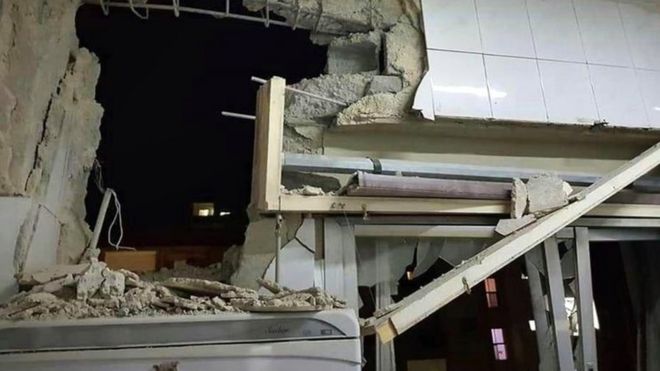
Israel says
it has hit dozens of targets in Syria belonging to the government and allied
Iranian forces.
The Israeli
military says the "wide-scale strikes" responded to rockets fired by
an Iranian unit into Israel.
Syria says
two civilians died and that Syrian air defences shot down most of the missiles
over Damascus. Other reports say the death toll was higher.
Local
reports said loud explosions were heard in the capital. Pictures on social
media showed a number of fires.
On Tuesday
morning, the Israeli military said it had intercepted four rockets fired from
Syria towards northern Israel. It said the rockets did not hit the ground
Israel has
carried out hundreds of strikes in Syria since the civil war broke out in 2011.
It has been
trying to thwart what it calls Iran's "military entrenchment" there
and block shipments of Iranian weapons to Lebanon's Hezbollah movement.
But the
latest operation was one of the broadest attacks to date, says the BBC's
Barbara Plett Usher in Jerusalem.
A senior
Israeli security official said the Israelis had decided on a powerful
retaliatory strike to signal they were "changing the rules" - that
even a small attack from Syria would trigger an extensive response, our
correspondent reports.

Early on
Wednesday, the Israel Defense Forces (IDF) tweeted that the strikes
targeted positions of Iran's Quds Force and Syria's armed forces.
"During
our strike of Iranian & Syrian terror targets, a Syrian air defence missile
was fired despite clear warnings to refrain from such fire. As a result, a
number of Syrian aerial defence batteries were destroyed," the IDF said.
The IDF also
said it held "the Syrian regime responsible for the actions that take
place in Syrian territory and warn them against allowing further attacks
against Israel".
Iran's Quds
Force is the external operations wing of the Islamic Revolution Guard Corps
(IRGC).
Israel did
not target the Russian-made advanced S-300 surface-to-air missile systems
deployed near the positions of Russian troops, Israeli media report.
Russia,
whose forces have helped turned the tide of Syria's civil war in favour of
President Bashar al-Assad, condemned the Israeli strikes.

Moscow,
whose air defence system covers most of Syria's airspace, generally does not
interfere with Israeli strikes on Iranian forces and their affiliates.
The leaders
of Russia and Israel enjoy good relations, and the Israeli military is said to
warn the Russian military before it carries out any attacks.
Syria's
state news agency Sana said that the country's "air defence confronted the
heavy attack and intercepted the hostile missiles".
It said that
Syria destroyed "most" of the Israeli missiles.
The news
agency added that the strikes on Syrian territory were carried out from
"Lebanese and Palestinian territories".
Israel has a
number of times hit targets inside Syria from war planes in Lebanese airspace.
Danny Makki,
a British-Syrian journalist based in Damascus, posted footage of what he said
he believed were Israeli missiles hitting targets south of Damascus.
Syria said
two civilians were killed in the Israeli strikes.
Meanwhile, a
UK-based monitoring group, the Syrian Observatory for Human Rights (SOHR), said
that 11 fighters, including seven foreigners, died.
The SOHR
said that the Israeli missiles hit sites in and around Damascus in Kiswa,
Saasaa, Mezzeh military airport, Jdaidat Artouz, Qudsaya and Sahnaya.
The Iranian
authorities have so far made no public comment.
The message
from Israel to Tehran is clear. Any attacks out of Syria will be met by a
disproportionate response.
Now it is
upping the military stakes.
But Iran is
sending a message of its own, too.
Despite a
long-running Israeli air campaign designed to constrain the Iranian build-up in
Syria, Tehran is determined that this project will continue.
It is a
close ally of the Assad regime in Damascus, and it sees Syrian territory both
as a frontline across which to confront Israel and as an important link to its
ally Hezbollah in Lebanon.
The Quds
(Jerusalem) Force answers directly to Iran's Supreme Leader, Ayatollah Ali
Khamanei.
It is led by
Maj Gen Qasem Soleimani, who is believed to be more than a mere military
commander.
Since the
US-led overthrow of Saddam Hussein's regime in Iraq in 2003, the Quds Force has
intensified its operations across the Middle East, providing training, funding
and weapons to non-state groups allied to Tehran.
It has also
developed forms of asymmetric warfare, such as swarm tactics, drone and
cyber-attacks, that have allowed Iran to undermine its enemies' superiority in
conventional weapons.
In April, US
President Donald Trump designated the IRGC, including the Quds Force, a
"foreign terrorist organisation" (FTO). It was the first time the US
had named a part of another government as an FTO.
The Quds
Forces has about 5,000 personnel, a recently published report by the US
military says.
FROM.bbc.com/news/world-middle-east-
No comments