
More than 30 Mourners Killed at Soleimani Burial
More than 30
people have been killed in a stampede as Iranians flocked to the burial of a
top commander killed in a US drone strike, Iranian media report.
The deaths
led to the postponement of Qasem Soleimani's interment. A new time will be
announced later, officials say.
Soleimani is
being laid to rest in his hometown of Kerman, with millions already estimated
to have packed the streets for funeral processions.
His killing
has raised fears of a conflict between the US and Iran.
Soleimani
was widely considered the second most powerful man in Iran behind Supreme
Leader Ali Khamenei. The US saw him as a terrorist and a threat to American
troops.
US President
Donald Trump adopted a tough stance against Iran after his election, and Tehran
responded with their own campaign. Tensions were raised further last month
after the US attacked an Iranian-backed militia in Iraq it blamed for attacks
on US forces.
It is
unclear what caused the stampede in Kerman, south-eastern Iran, but vast
numbers of people were in the streets ahead of Soleimani's burial, first set
for Tuesday morning.
The exact
death toll is unconfirmed - one emergency official put it at 32 while another
said it was 40. Nearly 200 people are also said to have been injured.
Top Iranian
officials have renewed their threats of revenge.
"The
martyr Qassem Soleimani is more powerful... now that he is dead," the
Revolutionary Guards' top general, Major General Hossein Salami, told crowds in
Kerman.
The Guards
were set up to defend Iran's Islamic system and are a major political and
military force.
Mourners
chanted "death to America" and "death to Trump", reporters
there said.
At one stage
the theme music to the 1970 US film Love Story was played, something BBC
Monitoring say may be more for its sentimentality rather than the film being
widely known in Iran.
On Monday,
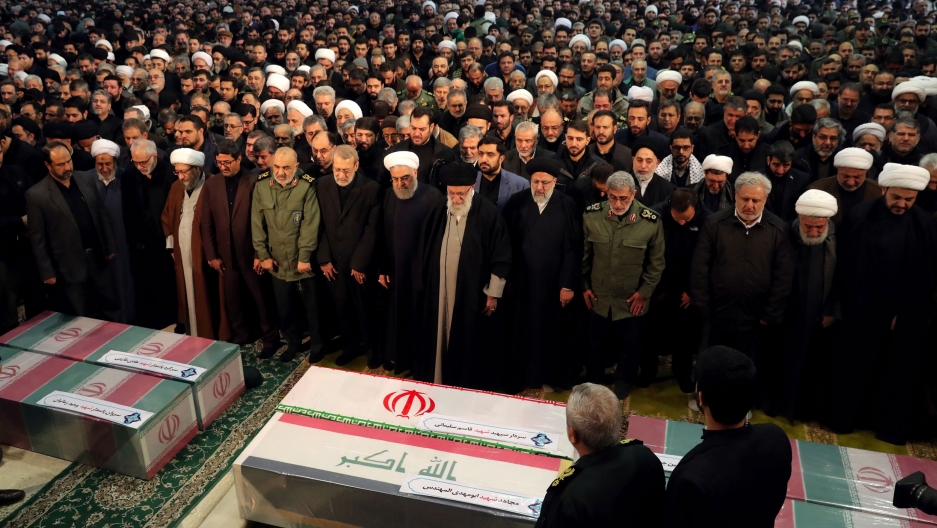
Ayatollah Khamenei led prayers at Soleimani's funeral in Tehran, at one point
weeping over his coffin.
Unconfirmed
estimates from Iranian state television put the number who took to the streets
of Iran's capital alone as "millions". The crowds were large
enough to be seen in satellite images.
Soleimani was head of the Quds force, the
overseas branch of the Revolutionary Guards. He was killed leaving Baghdad
airport on Friday.
In his
homeland, Soleimani was hailed by some as a national hero.
But he was
also a hardliner and a dominant force in a state that shot dead scores of
protesters at the end of 2019.
Soleimani
supported Syria's President Bashar al-Assad in the country's civil conflict,
aided the Shia militant group Hezbollah in Lebanon, and guided Iraqi militia
groups against the Islamic State group.
Justifying
the strike, President Trump said Soleimani was plotting "imminent"
attacks on US diplomats and military personnel.
Immediately
after his death, Iran threatened retaliation.
And on
Sunday,Tehran declared it would no longer abide by any of the restrictions imposed
by the 2015 nuclear deal. The deal limited Iranian nuclear capacities in
exchange for the lifting of economic sanctions.
In his
comments Mr Zarif said President Trump had been "misled" by Secretary
of State Mike Pompeo.
"He
[Pompeo] believes people were dancing in the streets of Tehran and Baghdad...
Now I think that he has seen the sea of humanity in Iraq and Iran yesterday.
Doesn't he want to admit that he's been misdirecting American foreign
policy?" Mr Zarif said.
Following
warnings from Iran, Mr Trump said that the US would respond in the event of
retaliation for Soleimani's death, "perhaps in a disproportionate
manner".
Trump
administration officials though have contradicted the US president on his
controversial threat to target Iranian cultural sites.
Such acts
could be considered war crimes. Secretary of Defense Mark Esper said "we
will follow the laws of armed conflict".
FROM bbc.com/news/world-middle-east
No comments