
Turkish MPs Approve Bill to Send Troops To Libya
Turkey's
parliament has passed a bill that will allow the government to deploy troops to
Libya to intervene in the civil war.
Turkish
lawmakers passed the bill on Thursday, with 325 in favour to 184 against.
Turkey is
allied with Libya's UN-backed government, which is based in the capital,
Tripoli.
The Libyan
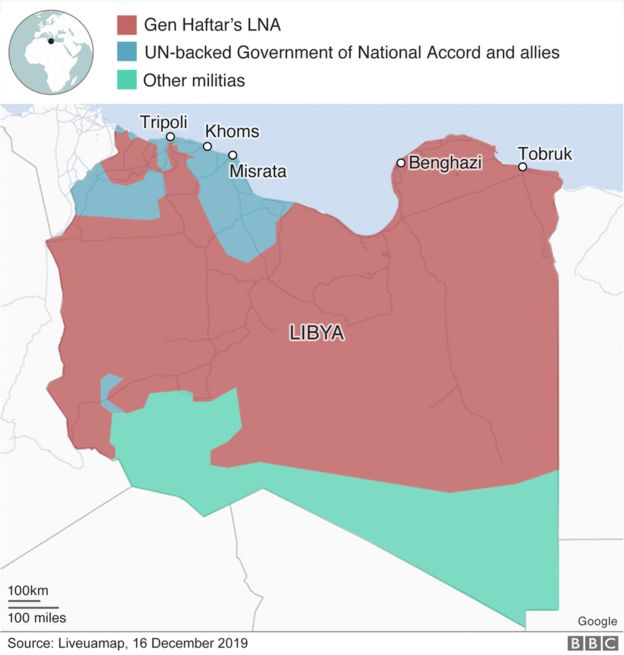
government has been fighting an insurgency by forces under Gen Khalifa Haftar,
based in eastern Libya.
Egypt, which
backs Gen Haftar, condemned Turkey's vote, saying it would "negatively
affect the stability of the Mediterranean region".
Last week,
Turkish President Recep Tayyip Erdogan said he would seek parliamentary approval
to provide military assistance following a request by the Tripoli government.
The bill
allows for the deployment of non-combat troops, to act as advisers and trainers
for government forces against Gen Haftar.
But experts
fear the legislation could deepen Turkey's involvement in the conflict and
increase tensions with Gen Haftar's backers, Egypt, Jordan and the United Arab
Emirates (UAE).
Turkish
Vice-President Fuat Oktay said the bill would be valid for one year, but gave
no details about the scale of the potential military deployment.
"We are
ready. Our armed forces and our defence ministry are ready," Mr Oktay
said.
The forces
of Gen Haftar have been trying to capture the capital city from the Government
of National Accord (GNA), led by Prime Minister Fayez al-Serraj.
Turkey
argues the Libyan conflict could threaten its interests in the country.
Libya has
been torn by violence and division since long-time ruler Muammar Gaddafi was
deposed and killed in 2011.
Since then,
the country has been racked by civil war, with no authority in full control.
The latest
episode of conflict started in April last year, when Gen Haftar launched an
attack on Tripoli in an attempt to oust the internationally recognised
government.
But eight
months on, the battle continues with the GNA keeping Gen Haftar's forces at bay
on Tripoli's southern outskirts.
In recent
weeks, the fighting escalated after Gen Haftar declared a "final" and
decisive battle for the capital.
Mr Oktay
said the passage of the bill sent a "political signal" to Gen
Haftar's forces.
"The
Libyan motion is important for the protection of the interests of our country
and for the peace and stability of the region," Turkey's Foreign Minister
Mevlut Cavusoglu tweeted after the vote.
In contrast,
Egypt said the bill amounted to "a flagrant violation of international
legitimacy" on the part of Turkey.
"Egypt
warns against the consequences of any Turkish military intervention in Libya
and stresses that such intervention will negatively affect the stability of the
Mediterranean region," Egypt's foreign ministry said in a statement.
Egyptian
President Abdul Fattah al-Sisi chaired a meeting of the National Security
Council to discuss "foreign military intervention" in Libya.
Before the
bill's passage, Mr Erdogan discussed the Libyan conflict with US President
Donald Trump in a phone call, the Turkish presidency said.
Mr Trump and
Mr Erdogan "stressed the importance of diplomacy in resolving regional
issues", it said.
Ankara risks
becoming even more deeply embroiled in Libya's civil conflict and its decision
to deploy troops marks a new stage in the internationalisation of the conflict.

Turkey has
already supplied armoured vehicles to the UN-recognised Government of National
Accord in Tripoli and also operates drones on its behalf.
Turkish
troops will apparently be deployed in a "training and advisory" role.
But this is a highly flexible description. If the Tripoli government has its
back to the wall, then Turkey may be compelled to take a more direct hand in
the fighting.
Gen Khalifa
Haftar's Libyan National Army is backed by Egypt, Jordan and crucially the UAE.
It has received direct support on the ground from semi-official Russian military
contractors and from Sudanese and Chadian mercenaries.
Turkey
clearly sees Libya as part of its strategic hinterland in the eastern
Mediterranean. It recently signed an economic agreement with Tripoli on energy
exploration. But Turkey's actions could leave it more isolated and stoke a
broader regional crisis.
No comments