
Hagia Sophia: Former Istanbul Museum Welcomes Muslim Worshippers
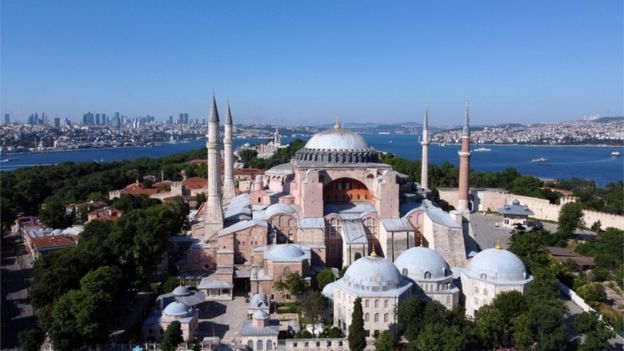
Crowds
gathered in Istanbul as the historic Hagia Sophia site opened for Friday prayers
for the first time since Turkish authorities ruled it could be converted into a
mosque.
Clerics in
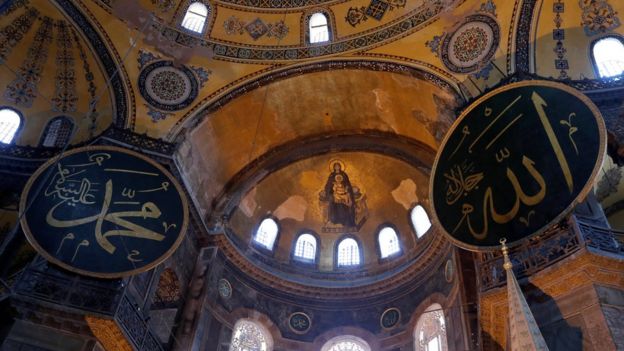
white robes sang from the Koran. Mosaics and frescoes of Jesus and Mary were
draped with curtains.
The
1,500-year-old Unesco World Heritage site became a museum in 1934.
This month a
Turkish court annulled its status, saying any use other than as a mosque was
"not possible legally".
The decision
to turn it back into a mosque was criticised by religious and political leaders
worldwide.
But
President Recep Tayyip Erdogan responded quickly to the ruling, vowing that the
world-famous site would be ready for Friday prayers from 24 July, and he was
seen joining worshippers at around midday (09:00 GMT).
About 1,000
people were allowed in through security checkpoints, while others laid out
prayer mats outside. An opening ceremony was followed by a formal prayer
service and proceedings were relayed outside on a big screen. Four muezzin
recited the call to prayer from each of the four minarets.
Hagia Sophia
was built as an Orthodox Christian cathedral and first converted into a mosque
after the Ottoman conquest nine centuries later.
While there
was considerable excitement as crowds headed to the Unesco site, not everyone
was happy. The secular opposition party that runs Istanbul has described the
move to turn it back into a mosque after 86 years as political rather than
religious.
Tens of
thousands of men and women waited for the call to prayer - many had travelled
from cities across Turkey.
Worshippers
took their places on the grass or on the pavement. The lucky ones found shade
under a tree.
Security was
tight across the historic peninsula of Istanbul, and at one point dozens of
worshippers broke through a police checkpoint. A group of men waved Turkish
flags and chanted "Allahu Akbar" (God is greatest).
While a
significant section of Turkish society has criticised the change to a mosque,
the emotion and enthusiasm outside it was palpable. A 45-year-old woman said she
had always liked Hagia Sophia as a museum, but "always thought it was a
cold building".
Now was the
moment for Turkey to reinforce its independence, she added. "We have been
waiting for this moment since our childhood."
Governor
Yerlikaya had urged those attending prayers on Friday to bring "[face]
masks, a prayer rug, patience and understanding" to help prevent the
spread of Covid-19.
As crowds
grew, he appealed for patience.
During a
sermon, Turkey's religious affairs agency president, Ali Erbas, held up a sword
in an apparent reference to Ottoman traditions. "Sultan Mehmet the
Conqueror dedicated this magnificent construction to believers to remain a
mosque until the Day of Resurrection," he said, referring to the emperor
who conquered Istanbul in the 15th Century.
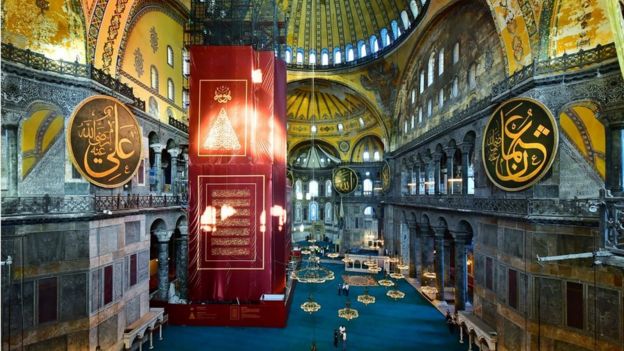
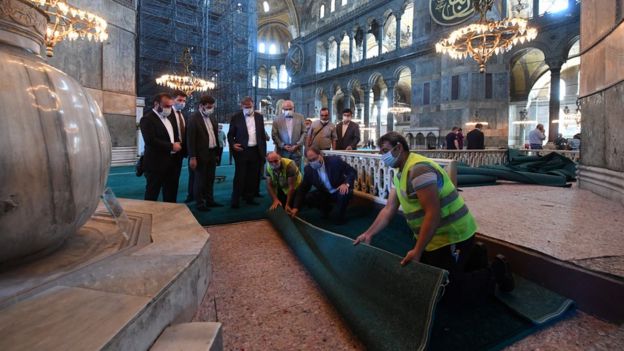
A turquoise
carpet had been laid on the floor to prepare for prayers and Christian relics
were covered up with white drapes or obscured by lighting
Scaffolding
was erected inside the dome as builders scrambled to convert the interior of
the ancient building. By Friday the scaffolding was largely covered by red
panelling.
Among the
Christian mosaics covered over on Friday was the Ninth-Century mosaic of the
Virgin Mary and Jesus inside the apse.
Islamist
groups and devout Muslims in Turkey had long called for Hagia Sophia to become
a mosque again, but secular opposition members opposed the move.
When
President Erdogan announced the decision on 10 July, it was met with widespread
criticism.
Pope Francis
responded by saying that his "thoughts go to Istanbul", adding:
"I think of Santa Sophia and I am very pained."
The head of
the Eastern Orthodox Church, Patriarch Bartholomew I, warned that the
conversion of the building would "disappoint millions of Christians"
and fracture two worlds.
The World Council
of Churches, a worldwide Christian organisation, warned the decision would sow
division.
Unesco said
it regretted the move, which further enflamed tensions with neighbouring
Greece, home to millions of Orthodox followers.
But Mr
Erdogan stressed that the country had exercised its sovereign right.
"After
86 years, Hagia Sophia will serve as a mosque again, in the way Fatih the
conqueror of Istanbul had indicated in his deed," he said.
He added
that the building would remain open to all Muslims, non-Muslims and foreign
visitors.
Many Turks
were sceptical. A former Erdogan ally, Ali Babacan, said Hagia Sophia had
"come to the agenda now only to cover up other problems".
Novelist
Orhan Pamuk told the BBC earlier this month that converting it back to a mosque
was a statement to the world that Turks did not want to be secular any more,
even though millions of Turks had been happy with its status as a museum.
The head of
the secular Republican People's Party (CHP), Kemal Kilicdaroglu, said that all
the president was concerned with was domestic politics. And a July opinion poll
suggested 43% of Turks saw the move as a way of avoiding discussion of the
country's economic difficulties.
The iconic,
domed building sits in Istanbul's Fatih district, on the west bank of the
Bosporus, overlooking the Golden Horn harbour.
Hagia
Sophia's complex history began almost 1,500 years ago, when Byzantine emperor
Justinian built the huge church in the year 537.
In 1453, in
a devastating blow to the Byzantines, Ottoman Sultan Mehmet II captured
Istanbul (formerly known as Constantinople) and Hagia Sophia - an Orthodox
Christian cathedral - was converted into a mosque for Friday prayers.
Four
minarets were added to the exterior, while ornate Christian icons and gold
mosaics were covered with panels of Arabic religious calligraphy.
After
centuries at the heart of the Muslim Ottoman empire, it was turned into a
museum in 1934 in a drive to make Turkey more secular.
It has since
become one of its most popular tourist sites, receiving more than 3.7 million
visitors last year.
Although it
has had a small prayer room since 1991, and calls to the faithful have been
heard before, Friday's event is the first mass prayers inside the site since
the 1930s.
FROM .bbc.com/news/world-europe
No comments