
Supreme Court Strikes out Suits against Virtual Hearing
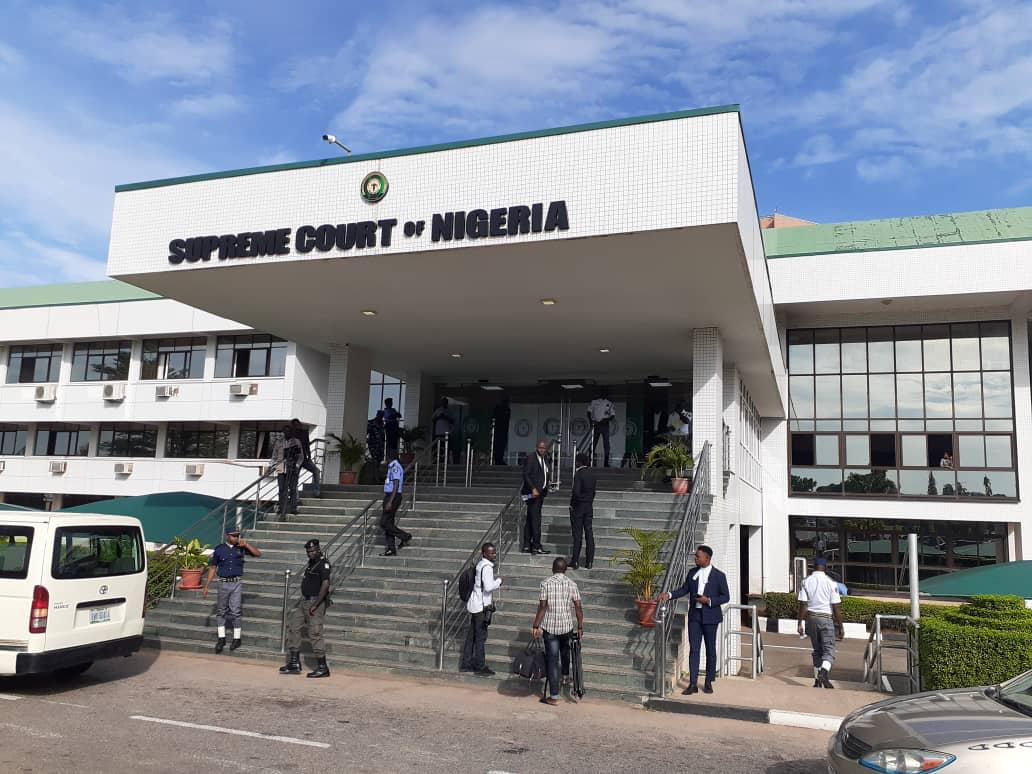
The Supreme
Court on Tuesday struck out two suits by Lagos and Ekiti States challenging the
validity and constitutionality of the Virtual Court Sittings procedure.
A seven man
panel presided over by Justice Bode Rhodes-Vivour struck out the suits after
they were withdrawn by the plaintiffs.
The first
suit with number: SC/CV/260/2020 filed by the Attorney General of Lagos State
has the Minister of Justice and the Attorney General of the Federation
and the National Assembly as the 1st and 2nd defendants respectively.
The Lagos
state government in the suit prayed the Supreme Court to determine whether
having regard to Section 36(1), (3) and (4) of the 1999 Constitution (as
amended) use of technology by remote hearings of any kind, whether by Zoom,
Microsoft Teams, WhatsApp, Skype or any other audio visual or video-conference
platform by the Lagos State High Court or any other Courts in Nigeria in aid of
hearing and determination of cases are constitutional.
When the
matter came up on Tuesday however, Lagos State Attorney General, Mr Moyosore
Onigbanjo SAN, having taken hint from the apex court that the suit was
speculative and preemptive withdrew the suit.
Following
its withdrawal, the apex court in a unanimous decision struck it out.
However,
Justice Rhodes-Vivour in his ruling held that, “As of today virtual sitting is
not unconstitutional”.
“This suit
is speculative and having been withdrawn, it is struck out”, he said.
The court
also struck out a similar suit marked, ‘’SC/CV/261/2020’’ filed by the
Attorney General of Ekiti state against the AGF, shortly after the suit was
withdrawn.
Just like
his Lagos counterpart, the Ekiti State AG, Mr Wale Fapounda, withdrew his suit
after taking the hint that the suit was preemptive.
On its part,
Ekiti State had challenged the constitutionality of the directive of the
Minister of Justice and the Attorney General of the Federation (AGF), Abubakar
Malami (SAN), to the Head of Courts at federal and state levels to adopt
Virtual Court Sittings in courts.
Fapohunda,
in the suit had asked the apex court to issue an order to annul the directive
for the adoption of the Virtual or Remote Court sittings for being inconsistent
with Section 1(3), 4(6), 5(2), 6(2), 36(3) and (4), 272 and 274 of the 1999
Constitution.
Ekiti State
further wants the Supreme Court to determine whether the AGF’s guidelines are
not a derogation from the legislative, executive and judicial law-making, law
execution and adjudicatory rules making powers exclusively vested in states of
the federation in respect of states courts, by virtue of Sections 1(3), 4(6),
5(2), 6(2), 272 and 272 and 274 of the Constitution.
He also
prayed the apex court to decide whether Lagos and Ogun state having adopted virtual
court hearings pursuant to the lockdown, the three arms of Government in Ekiti
State are bound to conduct their legislative, executive and judicial functions
pertaining to adjudication in state courts in compliance with the directive
upon which the National Judicial Council formulated the provisions of Articles
E(1) to E(13) of its Guidelines (issued on May 7, 2020).
FROM .thisdaylive.com/index.php/2020/07/14/supreme-court-strikes-out-suits-against-virtual-hearing
No comments