
Mass Protest Eclipses Belarus Leader's Rally

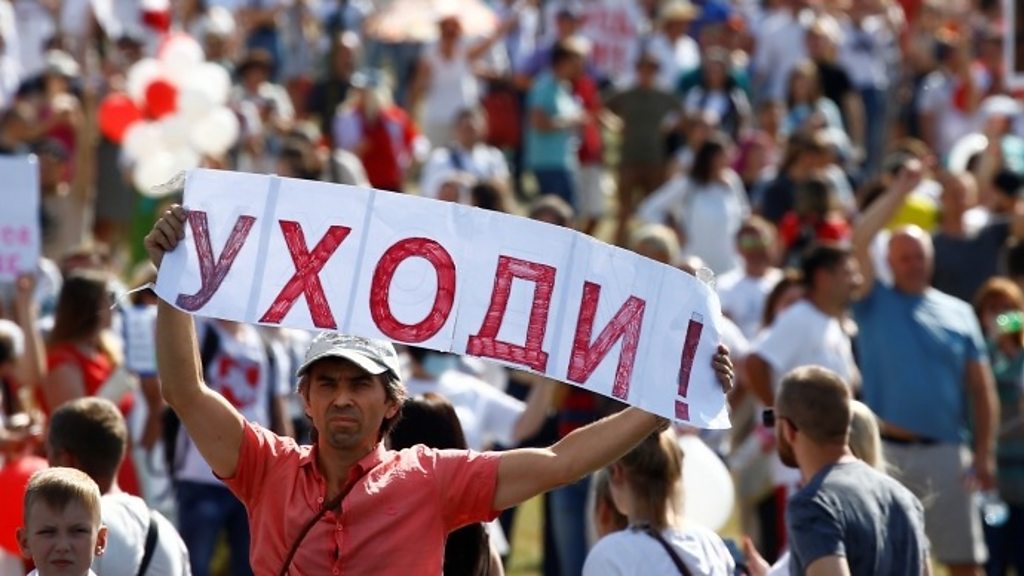
Tens of
thousands of opponents of Belarusian President Alexander Lukashenko have
gathered in Minsk to protest against disputed elections.
The
"March for Freedom" in the centre of the capital comes amid growing
anger over alleged poll-rigging and police violence at subsequent protests.
Meanwhile,
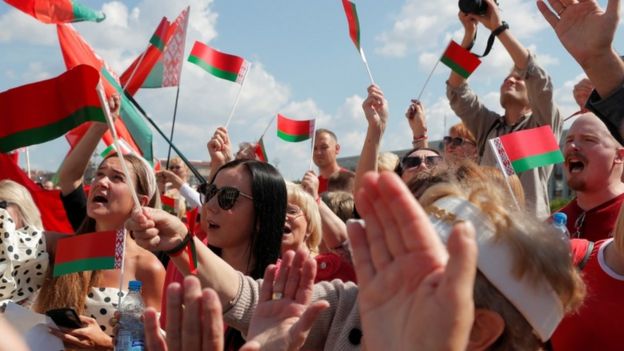
in an address to a smaller crowd of several thousand, Mr Lukashenko blasted
opponents as "rats".
He called on
supporters to defend their country and independence.
The rival
rallies were taking place after Russia agreed to offer security assistance in
the case of external military threats to Belarus. It emerged that Mr. Lukashenko
had twice spoken to President Vladimir Putin over the weekend.
The
long-time Belarus leader also voiced concerns over Nato military exercises
taking place in neighbouring Poland and Lithuania and launched into a tirade
against the Western military alliance.
Nato - who
sent four battle groups led by Britain, Canada, Germany, and the US to the
Baltic countries after Moscow's annexation of Crimea in Ukraine - rejected
allegations of a build-up in the region.
The unrest
in Belarus erupted after Mr Lukashenko claimed a landslide victory in last
Sunday's election, the result of which has been condemned amid widespread
allegations of vote-rigging.
The Central
Election Commission says Mr Lukashenko, who has been in power since 1994, won
80.1% of the vote and the main opposition candidate Svetlana Tikhanovskaya
10.12%.
But Ms
Tikhanovskaya insists that where votes were properly counted, she won support
ranging from 60% to 70%.
Russian TV
news bulletins have been making ominous parallels between Belarus 2020 and
Ukraine 2014.
Ukraine's
pro-Western revolution led to Moscow sending in its special operations forces
to annex Crimea and Russian military intervention in eastern Ukraine.
On paper, at
least, such a move would appear counter-productive. The opposition movement in
Belarus is not anti-Russia/pro-Europe - it is anti-Lukashenko. If Russia were
to send in troops to shore up the Belarusian leader, it risks alienating the
Belarusian people and creating anti-Moscow sentiment.
True, Moscow
is determined to keep Belarus within what it sees as Russia's sphere of
influence. The Kremlin's ultimate goal is deeper integration with its neighbour
- a fully-fledged union state (with Vladimir Putin at the helm). It could still
achieve this through political leverage.
The Kremlin
has a pathological fear of "coloured revolution" on its doorstep. But
Minsk 2020 is not Kyiv 2014. Belarus is not choosing between East and West. The
Belarusian people are outraged by the brutality of their security forces. So
much so that even Mr Lukashenko's traditional base - including the state
factory workers - are deserting him.
Local media
reports suggest that around 31,000 people took part in the pro-government
rally, though the Ministry of Internal Affairs estimated that the number was
closer to 65,000.
Speaking to
supporters, Mr Lukashenko said he did not like rallies and did not need anyone
to defend him. He said it was not his fault that he had to ask for their help.
Rejecting calls for a re-run of the presidential election he said Belarus would
"die as a state" if that happened.
"You
came here so that for the first time in a quarter-century you could defend your
country, your independence, your wives, sisters and children," he said.
He added
that the opposition would "crawl like rats out of a hole" if they
were not suppressed this time.
"This
will be the beginning of your end - you will go down on your knees like in
Ukraine and other countries and pray, God knows to whom."
There were
reports of state sector workers being forced to attend or face the threat of
losing their jobs. For days, workers at state-run factories have staged
walkouts and many have joined street marches against the president.
As the president spoke, around 220,000 of anti-Lukashenko protesters gathered near the
Stela Minsk Hero City World War Two memorial in central Minsk, according
to news website Tut.by.
They had
answered a call for weekend rallies from Ms Tikhanovskaya. The opposition
leader had gone into exile in Lithuania after she registered a complaint with
electoral authorities and spent seven hours in detention.
Maria
Kolesnikova, a former member of Ms Tikhanovskaya's team, addressed the crowds.
"You
are incredible, I love you", she said, before appealing to officials,
security officials and judges..
"Guys,
this is the last chance. Take the side of the good and the people. We are in
the majority. We are in power."
Supporters
also turned out in other cities. The mayor of Brest was booed by protesters
when he tried to speak to crowds. In Gomel, demonstrators removed the official
flag of Belarus from the city's flagpole and replaced it with the red and white
flag of the opposition.
Belarusian
footballer Ilya Shkurin announced he would not play for his country until
President Lukashenko stepped down and then scored his first goal for
Russian premier league team CSKA Moscow.
As the
unrest continued, Mr Lukashenko sought help from Russian President Vladimir Putin.
Mr
Lukashenko said President Putin had promised to provide what he called
comprehensive assistance in the event of external military threats to Belarus.
The two
leaders had a second conversation on Sunday, in which the Kremlin said they
discussed "the situation in Belarus, taking into consideration the
pressure the republic was being put under from outside".
Mr Putin
told Mr Lukashenko Russia was ready to assist Belarus "in accordance with
the collective military pact if necessary".
EU foreign
ministers agreed on Friday to prepare new sanctions against Belarusian
officials responsible for "violence, repression and the falsification of
election results". The US has also condemned the election as "not
free and fair".
The prime
ministers of three Baltic republics - Latvia, Lithuania and Estonia - later
"expressed deep concern at the violent crackdown... and the political
repression of the opposition by the authorities".
Lithuania
and Latvia have previously said they are prepared to mediate in Belarus,
provided the authorities stopped violence against protesters and formed a
national council with members of civil society. They warned that the alternative was sanction.
The leaders
said the presidential election was "neither free nor fair" and called
for a "transparent" vote "with the participation of
international observers".
Some 6,700
people were arrested in the wake of the election, and many have spoken of
torture at the hands of the security services.
FROM .bbc.com/news/world-europe
No comments