
UKMPs Seek New Ways to Break Brexit Deadlock
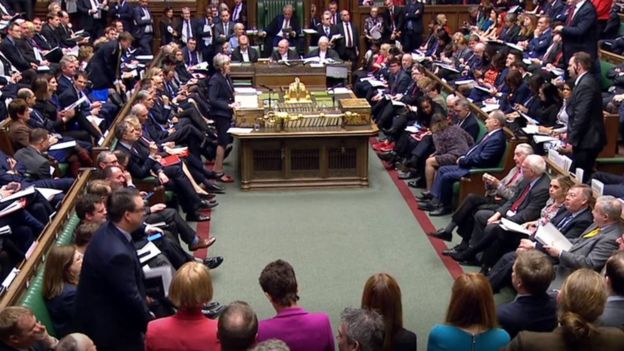
MPs are
starting to debate the process of voting on their preferred Brexit options, as
Theresa May prepares to meet Tory backbenchers in an effort to win them over to
her agreement.
Some MPs
want the PM to name the date she will leave No 10 to have any hope of getting
their backing for her deal.
The BBC's
Laura Kuenssberg said some leading Brexiteers were "tiptoeing their
way" towards supporting her plan.
Jacob
Rees-Mogg has said of the deal: "Half a loaf is better than no
bread."
He told BBC
Radio 4's Today programme he did not "begin to pretend this is a good deal
or a good choice", but he would support the PM's plan if it had the
backing of the Democratic Unionist Party.
The 10
Northern Irish MPs are seen as the key to securing the deal, but they have
urged Tory MPs to "stand firm" in their opposition unless there were
"significant changes".
Commons
leader Andrea Leadsom said the government was still in talks to persuade the
DUP to back it, along with other MPs on their own benches.
Meanwhile,
the President of the European Council Donald Tusk told MEPs they "cannot
betray the six million people who signed the petition to revoke Article 50, the
one million people who marched for a people's vote, or the increasing majority
of people who want to remain in the EU".
He said the
people "may feel that they are not sufficiently represented by the UK
Parliament, but they must feel that they are represented by you... because they
are Europeans".
Having voted
to seize control of Commons business, backbench MPs will vote on Brexit
alternatives later.
MPs are
currently debating a motion which determines how the rest of the day's debate
will be carried out.
Conservative
backbencher Sir Oliver Letwin, whose cross-party proposal ushered in today's
debate, said the only way leaving the EU with no-deal can be prevented is by
crystallising an alternative majority and trying to carry it forward.
He said that
if MPs supported the prime minister's deal in another meaningful vote this
would be "the easy route".
He said he
"profoundly hopes" that if on Monday there is a majority view in
favour of a particular position, that the government will say that it will
carry that forward.
Conservative
MPs will be given a free vote, meaning they will be able to support or reject
any proposal without pressure from party whips. Cabinet ministers will be
abstaining.
The decision
followed warnings that more than a dozen ministers might quit if they were told
they had to follow party orders.
Labour MPs
are being whipped to support the party's own proposal as well as a number of
others, including one for a referendum to endorse any deal.
There was
some confusion over the confirmatory public vote option. Labour MP Peter Kyle
helped draw up the motion and told Today that he expected his leader Jeremy
Corbyn to order his MPs to back it.
But his
colleague Barry Gardiner cast doubt on the support from Labour's frontbench,
telling the programme the amendment makes it "look like a public vote is
an attempt to Remain", adding: "It is not where out policy has
been."
MPs later
confirmed to the BBC they had been ordered to support the proposal.
The DUP's
leader in Westminster, Nigel Dodds, has co-signed two proposals - one
asking for the result of the EU referendum in 2016 to be respected and another
backing the Malthouse Compromise.
Mrs May
continues to try to win MPs round to her deal, which has been heavily rejected
twice. She is expected to address the Conservative backbench 1922 Committee on
Wednesday evening.
Ms Leadsom
said there was a "real possibility" the PM's deal could come back for
a vote on Thursday or Friday, adding: "If we could simply get the
withdrawal agreement bill under way…once we have done that, once we have left
the EU, we can then look at what our future relationship will look like."
And during
Prime Minister's Questions - after being told by her fellow Tory MP Andrew
Bridgen that his constituents could not trust her to deliver Brexit - Mrs May
said she could guarantee delivering on Brexit if "this week" MPs like
him supported her deal.
Friday is
the day written into law for the UK to leave the EU, but later MPs will vote on
a statutory instrument to confirm a delay - with the earliest Brexit is likely
to happen now being 12 April.
Writing in
the Daily Mail, Mr Rees-Mogg - who is chairman of the pro-Brexit European
Research Group of Tory MPs - said "an awkward reality needs to be
faced" and he was ready to back the deal so long as it won DUP support.
Fellow ERG
member, Tory MP Daniel Kawczynski, tweeted that he had appealed to members of
the DUP to abstain from voting on the PM's plan if they cannot back it, saying
it could be enough to get the deal "across the finishing line".
But
ex-Foreign Secretary Boris Johnson told the BBC there was "no point"
supporting Mrs May's deal "without any sign the UK is going to change its
approach in phase two" of the negotiations. Otherwise he said he feared
the country would be indefinitely tied to the EU's rules.
BBC
political editor Laura Kuenssberg said the not-so-subtle subtext of Mr
Johnson's remarks was "if the PM promises to go soon, then she might get
my vote".
According to
a copy of a business motion released by Labour's Hilary Benn, there will
be about five hours of debate on different options.
The Speaker
will select around half a dozen options, with MPs marking on paper each option
with a "yes" or "no".
MPs will use
both lobbies for completing the indicative vote ballots.
Voting by
paper ballot will take place at about 19:00 GMT, with the results announced by
Mr Bercow later that evening.
The process
is likely to continue on Monday as MPs seek to whittle down options which could
command majority support in Parliament.
The
government has until 12 April to propose a different way forward to the EU if
it cannot get the current agreement through Parliament.
FROM .bbc.com/news/uk-politics-
No comments