
Ethiopian Airlines Boeing 737 Pilots 'Could Not Stop Nosedive'
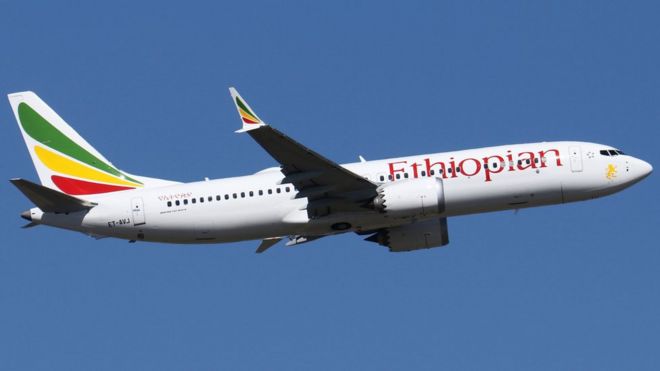
The
Ethiopian Airlines plane that crashed last month nosedived several times before
it hit the ground, a preliminary report has said.
Pilots
"repeatedly" followed procedures recommended by Boeing before the
crash, according to the first official report into the disaster.
Despite
their efforts, pilots "were not able to control the aircraft",
Transport Minister Dagmawit Moges said.
Flight ET302
crashed after take-off from Addis Ababa, killing 157 people.
It was the
second crash of a Boeing 737 Max aircraft in five months.
Last
October, Lion Air flight JT 610 crashed into the sea near Indonesia killing all
189 people on board.
In a news
conference in Addis Ababa, Ms Dagmawit said: "The crew performed all the
procedures repeatedly [that were] provided by the manufacturer but were not
able to control the aircraft."
Her comments
were based on a preliminary report into the crash, which has not been published
yet, but could be released by the end of the week.
The 737 Max
family of aircraft was grounded following the Ethiopian Airlines crash, a move
affecting more than 300 planes.
The
preliminary report did not attribute blame for the crash and did not give
detailed analysis of the flight.
But it did
suggest that Boeing review the aircraft control system and said aviation
authorities should confirm the problem had been solved before allowing the 737
Max back into the air.
In a
statement, the chief executive of Ethiopian Airlines, Tewolde GebreMariam, said
he was "very proud" of the pilots' "high level of professional
performance".
"It was
very unfortunate they could not recover the airplane from the persistence of
nosediving," the airline said in a statement.
Investigators
have focused their attention on the Manoeuvring Characteristics Augmentation
System (MCAS) - software designed to help prevent the 737 Max from stalling.
The software
reacts when sensors in the nose of the aircraft show the jet is climbing at too
steep an angle, which can cause a plane to stall.
An
investigation into the Lion Air flight suggested the system malfunctioned, and
forced the plane's nose down more than 20 times before it crashed into the sea.
The
preliminary report from Indonesian investigators found that a faulty sensor on
the aircraft wrongly triggered MCAS without the pilots' knowledge
Boeing has
been working on an upgrade of the MCAS software since the Lion Air crash.
It has said
the system can be disabled - allowing pilots to regain control if there appears
to be a problem.
But the
latest comments from Ethiopian officials suggest that pilots could not regain
control, despite following procedures recommended by Boeing.
Two crashes,
five months apart, with a total of 346 people dead.
Both
preliminary crash reports suggest a new design to the 737 Max 8 malfunctioned,
pushing each plane repeatedly into a nosedive.
One lawsuit
has been filed. More are likely.
The
suffering of those who've lost loved ones can't be quantified. But the
commercial toll for the manufacturer and damage to its reputation, at this
stage, can't be either.
Hundreds of
737 Maxs are grounded worldwide. Thousands of orders are, for now on ice, and
some could even be in jeopardy.
The Max was
Boeing's answer to Airbus' A320: a single-aisle, fuel-efficient short-haul
plane.
But in the
opinion of one experienced 737 pilot, the new anti-stall system, which was
added to the aircraft and contributed to both crashes, was "flawed".
Boeing is
working to fix it. It needs to get the aircraft certified as safe and back in
the air as soon as it can.
Boeing has
issued guidance to pilots on how to manage MCAS.
It plans to
install an extra warning system on all 737 Max aircraft, which was previously
an optional safety feature.
It is also
revising pilot training to provide "enhanced understanding of the 737
Max" flight system and crew procedures.
The
planemaker says the upgrades are not an admission that MCAS caused the crashes.
FROM .bbc.com/news/business-
No comments