
Record Number Bushfires Emergencies Hit Australia
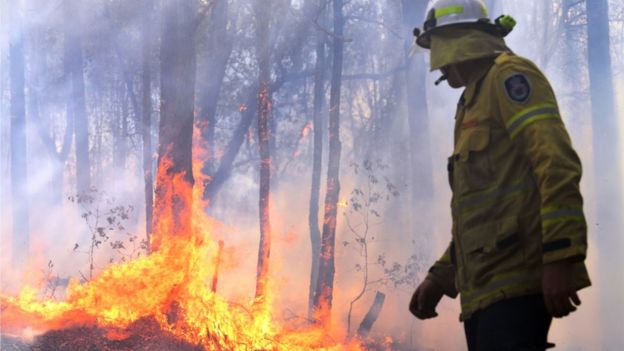
Australian
authorities say an "unprecedented" number of emergency-level
bushfires are threatening the state of New South Wales (NSW).
More than 90
blazes were raging across the state on Friday.
Gusty winds
and up to 35C heat have exacerbated the fires, many of which are in
drought-affected areas.
There are
reports of people trapped in their homes in several places, with crew unable to
reach them due to the strength of the fires.
"We are
in uncharted territory," said Rural Fire Service Commissioner Shane
Fitzsimmons. "We have never seen this many fires concurrently at emergency
warning level."
At one
point, 17 emergency-level fires were burning simultaneously across NSW.
Authorities
have deployed more than 1,000 firefighters and 70 aircraft to save "as
many people as possible", Mr Fitzsimmons said.
The Rural
Fire Service tweeted on Friday that "due to the size and speed of the
fires we couldn't get to everyone, even by road or helicopter". The blazes
are spread across about 1,000 km (621 miles) of Australia's coast, stretching
the emergency response.
Some people
were warned to seek shelter from fires rather than flee, as it was now too late
to leave.
Emergency
warnings were also issued on Friday for bushfires burning in Queensland and
Western Australia.
In NSW, the
worst-hit state, crews have fought hundreds of fires since September. Last
month, two people died while trying to protect their home.
Last week,
one blaze burnt though 2,000 hectares of bush which contained a koala
sanctuary. Hundreds of the animals were feared to have died.
Rains lashed
NSW earlier this week, providing much relief to farmers. But the storms were
not nearly enough to end the long-running drought.
Authorities
in the state warn that many fires will continue to burn unless there is more
rain.
"We
just cannot overstate the profound impact that the drought is having on fire
behaviour," Mr Fitzsimmons said.
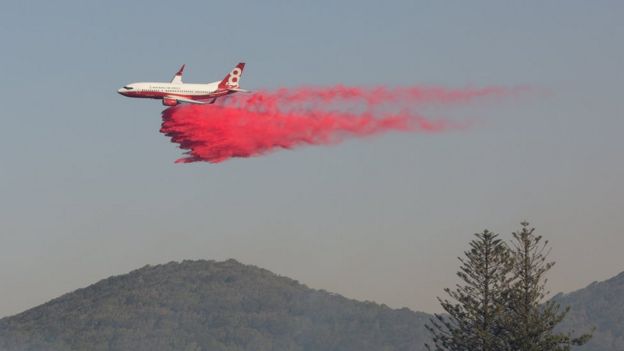
Water-bombing
aircraft are often flying long distances because of the difficulty of accessing
water in dry areas. In some cases authorities have drilled bores to keep up
with demand.
"We've
very mindful of the scarcity of water and how precious it is but the reality is
we can't do firefighting without water," Mr Fitzsimmons said.
Rains lashed
NSW earlier this week, providing much relief to farmers. But the storms were
not nearly enough to end the long-running drought.
Authorities
in the state warn that many fires will continue to burn unless there is more
rain.
"We
just cannot overstate the profound impact that the drought is having on fire
behaviour," Mr Fitzsimmons said.
Water-bombing
aircraft are often flying long distances because of the difficulty of accessing
water in dry areas. In some cases authorities have drilled bores to keep up
with demand.
"We've
very mindful of the scarcity of water and how precious it is but the reality is
we can't do firefighting without water," Mr Fitzsimmons said.
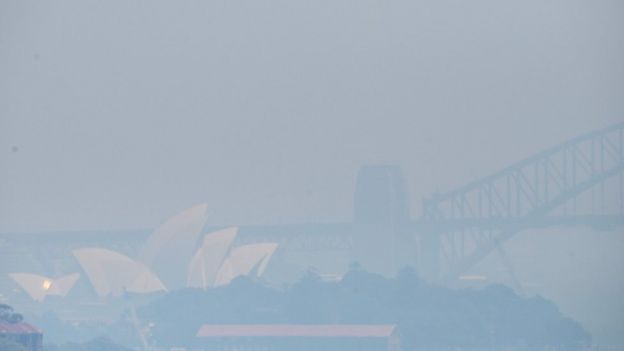
Last week,
Sydney was blanketed by smoke for days due to fires in Port Macquarie - a
region 380km away.
The poor air
quality prompted health warnings for those with asthma and other respiratory
problems.
Australia's
fire season risks growing longer and more intense due to climate change,
according to scientists.
Authorities
said they were concerned about the severity of the fires ahead of its hottest
months, a year after the nation experienced its warmest summer on record.
Officials
have confirmed that 2018 and 2017 were Australia's third and fourth-hottest
years on record respectively.
The
bureau's State of the Climate 2018 report said climate change had led to
an increase in extreme heat events and increased the severity of other
natural disasters, such as drought.
Even if
global temperatures are contained to a 2C rise above pre-industrial levels - a
limit set out in the landmark Paris accord, agreed by 188 nations in 2015
- scientists believe the country is facing a dangerous new normal.
Last
year, a UN report said Australia was falling short in efforts to cut its
CO2 emissions.
No comments