
Formula 1 Teams Reject Pirelli 2020 Tyre Design
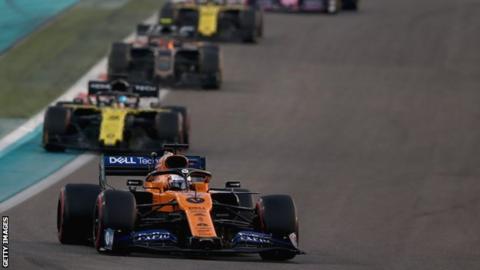
Formula 1
teams have unanimously rejected the tyres proposed by supplier Pirelli for the
2020 season.
The Italian
company had hoped the new design would be a step forward in plans to introduce
less sensitive tyres, on which drivers can push and race harder.
But at a test
in Abu Dhabi last week, teams preferred the 2019 tyres.
A statement
from governing body the FIA said: "The lessons learned will be invaluable
for the further improvement of the tyres in the future."
Pirelli was
not immediately able to comment.
The decision
to stick with the 2019 models is a blow both to Pirelli and F1 in their plans
to produce tyres that are more raceable than those that have been used in
recent years.
The drivers,
under their representative organisation the Grand Prix Drivers' Association
(GDPA), have been pushing for the tyres to be made more durable so they can
push flat out and race harder than they have so far been able to in the Pirelli
era.
The Pirelli
tyres used in F1 since 2011 have a tendency to overheat when pushed hard, which
means drivers cannot push flat out or follow another car closely for any
significant period of time.
This means
races are dominated by tyre management, which means driving to a pre-set pace
that keeps the tyres within their temperature window and which is well below
the absolute limit of the car.
At some
races, drivers cannot even push flat out for a full qualifying lap.
F1 is
introducing major rule changes for 2021 with the aim of closing up the field
and making overtaking easier, and Pirelli has been tasked with improving its
tyres with the same aim.
FIA
president Jean Todt said at the season-closing race in Abu Dhabi that the tyres
needed to be "addressed for 2021".
But Pirelli's
attempts to introduce a new, more durable design for 2020 have hit problems
from the start.
Ferrari
driver Sebastian Vettel was unconvinced by the tyres on his first experience of
them at a test in Barcelona before the Japanese Grand Prix in October.
And when all
the teams tried them in practice at the United States Grand Prix later that
month, the drivers were unanimous in their criticism of them.
Vettel
called them a "disappointment" and McLaren's Carlos Sainz said they
felt "very weird and very bad".
Pirelli F1
boss Mario Isola said at the time that the test in the USA had been less
effective than hoped because of the unusually cool conditions in Austin that
day.
But the
tyres were not met with any greater approval in the more representative
conditions in Abu Dhabi.
Haas driver
Romain Grosjean, a director of the GPDA, said at the Abu Dhabi test:
"There are some positives and negatives. It's early days. Is it a big
change and what everyone would like to have? No.
"We
need to look at how we've been running the cars and to make sure we are on the
maximum of everything.
"But if
you ask me if I'm very happy about the new tyres and this is going to solve
some of the problems - the thermal degradation, sensitivity to following
another car - I just have to tell the truth - no, it's not going to change the
problem fully."
Senior
figures in F1 hope the move to 18-inch wheels and lower profile tyres for 2021
will make it easier to design tyres that fit the required criteria.
Testing on
the 2021 rubber has already begun - Pirelli completed a two-day test in Abu
Dhabi at the weekend with a 2019 Mercedes driven by Williams driver George
Russell using 18-inch wheels.
FROM .bbc.com/sport/formula1
No comments