
Trump impeachment: House of Reps Unveil Formal Charges
A
Democratic Party aide said the articles of impeachment would focus on abuse of
power and obstruction of Congress.
Mr
Trump is accused of withholding aid to Ukraine for domestic political reasons.
He
insists he has done "nothing wrong" and dismissed the process as
"madness".
The expected
announcement by the House of Representatives judiciary panel would lead to an
impeachment vote by the full lower chamber.
If
the articles are approved by the House - which is controlled by the Democrats -
a trial in the Republican-held Senate will take place, possibly early in
January.
The House Judiciary
Committee is believed to have drawn up articles of impeachment, following two
months of congressional hearings.
The
impeachment process was launched after an anonymous whistleblower complained to
Congress in September about a July phone call by Mr Trump to the president of
Ukraine.
In
the phone call, Mr Trump appeared to tie US military assistance to Ukraine
launching investigations which could help him politically.
In
return for those investigations, Democrats say Mr Trump offered two bargaining
chips - $400m (£304m) of military aid that had already been allocated by
Congress, and a White House meeting for President Volodymyr Zelensky.
Democrats
say this pressure on a vulnerable US ally constitutes an abuse of power.
The
first investigation Mr Trump wanted from Ukraine was into former Vice-President
Joe Biden, his main Democratic challenger, and his son Hunter. Hunter Biden
joined the board of a Ukrainian energy company when his father was President
Obama's deputy.
The
second Trump demand was that Ukraine should try to corroborate a conspiracy
theory that Ukraine, not Russia, had interfered in the last US presidential
election. This theory has been widely debunked, and US intelligence agencies
are unanimous in saying Moscow was behind the hacking of Democratic Party
emails in 2016.
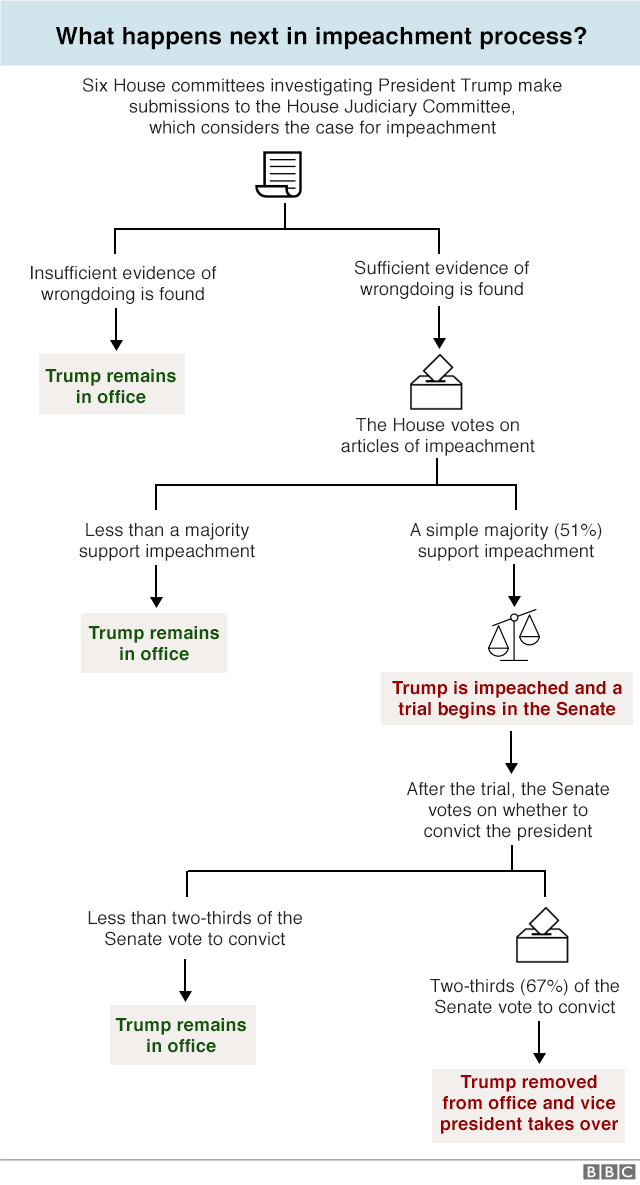
Impeachment is the
first part - the charges of a two-stage political process by which Congress can
remove a president from office.
If,
following the hearings, the House of Representatives votes to pass articles of
impeachment, the Senate is forced to hold a trial.
A
Senate vote requires a two-thirds majority to convict and remove the president unlikely
in this case, given that Mr Trump's party controls the chamber.
Only
two US presidents in history Bill Clinton and Andrew Johnson have been
impeached, but neither was convicted.
President
Richard Nixon resigned before he could be impeached.
No comments