
Sweden Considers Reviving Julian Assange Rape Inquiry
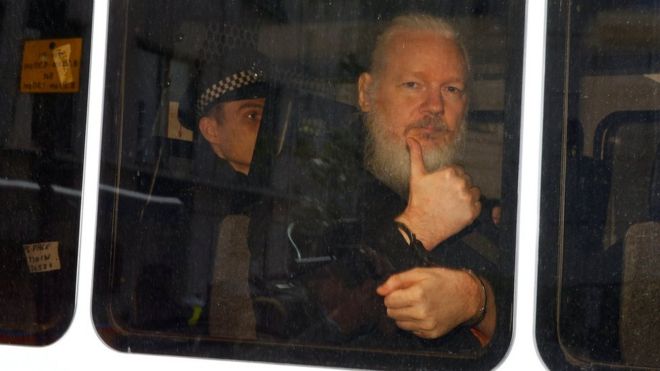
Wikileaks
co-founder Julian Assange could face a renewed investigation into an allegation
of rape in Sweden.
Assange, 47,
who had been granted asylum in Ecuador's London embassy for seven years, was
arrested on Thursday.
Swedish
prosecutors said they were examining the case at the request of the alleged
victim's lawyer.
The US also
wants to extradite him from the UK over his alleged role in one of the largest
ever leaks of government secrets in 2010.
Australian-born
Assange faces a charge of conspiracy to commit computer intrusion in the
US for his alleged role in one of the largest ever leaks of government
secrets in 2010, which could result in a prison term of up to five years.
Lawyer
Elizabeth Massi Fritz said she would do "everything we possibly can"
to get the investigation reopened in Sweden.
Assange
sought refuge in the Knightsbridge embassy in 2012 to avoid extradition to
Sweden over allegations of sexual assault. But Ecuador abruptly withdrew its
asylum and invited the police to arrest him on Thursday.
After his
dramatic arrest, he was taken to Westminster Magistrates' Court and found
guilty of a British charge of breaching bail. He spent Thursday night in
custody and is facing up to 12 months in prison for that conviction.
The United
Nations has called for his right to a fair trial to be respected during any
extradition process.
Assange was
accused of rape and other sexual offences, against two women, following a
Wikileaks conference in Stockholm in 2010. He has always denied the
allegations, saying the sex was consensual.
Swedish
prosecutors dropped the rape investigation in 2017 because they were
unable to proceed while he remained in the Ecuadorean embassy.
Assange also
faced investigation for molestation and unlawful coercion, but these cases were
dropped in 2015 because time had run out.
Prosecutors
will now re-examine the rape case to decide whether to resume it before the
statute of limitations runs out in August 2020.
Ms Massi
Fritz, lawyer for the alleged victim, said the arrest came as a shockbut
"what we have been waiting and hoping for since 2012 has now finally
happened".
She said:
"No rape victim should have to wait nine years to see justice be
served."
Assange is
due to face a hearing over his possible extradition to the US on 2 May.
The US
Department of Justice has accused him of conspiring with former intelligence
analyst Chelsea Manning to commit "one of the largest compromises of
classified information in the history of the United States".
Manning was
arrested in 2010 for disclosing more than 700,000 confidential documents,
including a video of US soldiers killing civilians from a helicopter in
Iraq. She was recently jailed for a second time for refusing to
testify in an investigation into Wikileaks.
Assange's
lawyer Jennifer Robinson said they would be fighting the extradition request.
She said it set a "dangerous precedent" for journalists publishing
information about the US.
Jonathan
Turley, a law professor at George Washington University, said the charges
had been crafted to avoid free speech concerns by accusing Assange of
participating in the theft of information. But he said the indictment was
"thin on evidence".
During a
briefing at the White House following Assange's arrest, US President Donald
Trump was asked by reporters if he stood by his election campaign remark that
he loved Wikileaks, which released damaging information on his opponent Hillary
Clinton.
"I know
nothing about Wikileaks," said Mr Trump. "It's not my thing."
With Assange
facing extradition proceedings and up to five years in federal prison on the US
computer hacking charge, shadow home secretary Diane Abbott told BBC Radio 4's
Today programme that the UK should resist handing him over.
She said:
"This is all about Wikileaks and all of that embarrassing information
about the activities of the American military and security services that was
made public."
Initially Ms
Abbott dismissed the Swedish allegations, saying three times that Assange was
never charged, but she later said he should face the criminal justice system if
the Swedish government does charge him.
Labour
leader Jeremy Corbyn also said the UK should oppose Assange's extradition,
"for exposing evidence of atrocities in Iraq and Afghanistan".
The BBC's
diplomatic correspondent James Landale said backing Assange is not without
political risk and will not find universal favour among Labour MPs - but it
means "the battle over Assange's future will now be as much political as
it is legal".
Prime
Minister Theresa May welcomed the arrest, saying it showed that "in the
UK, no one is above the law".
Lawyer
Rebecca Niblock said the extradition decision lies primarily with the courts
and that only a judge can decide whether an extradition breaches an
individual's human rights.
The home
secretary can consider a limited number of issues when deciding whether or not
to order an extradition, including whether the person is at risk of the death
penalty.
However, if
Sweden also made an extradition request, Ms Niblock said it would be for the
home secretary to decide which request would take precedence, considering
factors such as the seriousness of the offence and which request was made
first.
Nick Vamos,
former head of extradition at the Crown Prosecution Service, said the UK
proceedings should not take more than 18 months.
Considering
Assange's potential objections to extradition, Mr Vamos said that he did not
think courts would accept the US case was politically motivated.
But he said
Assange may be able to argue that his likely treatment in the US prison system
would breach his human rights and that could not receive a fair trial due to
his notoriety and links to political scandals.
FROM .bbc.com/news/uk-
No comments